

Clinical Trial Representation Estimator
How Many Patients Would Be Excluded?
Based on the article, typical clinical trials exclude 80% of patients seen in real-world settings. Estimate how many patients would be excluded from your study based on common exclusion criteria.
Input Your Patient Population
Results
Total Patients
1,000
Trial Population
200
Exclusion Reasons
When a new drug hits the market, you might assume its success is proven by clinical trials alone. But here’s the catch: the people in those trials aren’t most patients. Clinical trials are tightly controlled experiments. Real-world outcomes show what actually happens when that same drug is used by millions of people with different health conditions, lifestyles, and access to care. The gap between these two worlds isn’t just a technical detail-it’s a gap in patient outcomes.
Why Clinical Trials Don’t Reflect Real Patients
Clinical trials are designed to answer one clear question: Does this treatment work under ideal conditions? To get a clean answer, researchers exclude almost everyone who doesn’t fit a narrow profile. In cancer trials, for example, only about 20% of patients seen in hospitals actually qualify. Why? Because they have other illnesses like diabetes or heart disease. They’re older than 75. They’re taking other medications. Or they live too far from the trial site. A 2023 study in the New England Journal of Medicine found Black patients were 30% more likely than White patients to be excluded-not because their cancer was worse, but because of socioeconomic barriers like transportation, work schedules, or distrust in the medical system. These exclusions aren’t random. They’re built into the rules. And that means the results you see in press releases? They’re based on a group that’s healthier, younger, and more privileged than the average patient.What Real-World Data Actually Shows
Real-world outcomes come from the messiness of everyday medicine. They’re pulled from electronic health records, insurance claims, wearable devices, and patient registries. This data includes people with multiple chronic conditions, elderly patients on five different meds, and those who miss appointments or skip doses. In other words, it’s the population you and your family belong to. One study comparing 5,734 patients from clinical trials to 23,523 from real-world records found stark differences. Real-world patients had data collected irregularly-sometimes every few months, sometimes not for over a year. Only 68% of their records had complete information on key outcomes, compared to 92% in trials. Their health changes weren’t measured on a schedule; they were tracked when they walked into a clinic, got an X-ray, or filled a prescription. This isn’t a flaw-it’s the point. Real-world data doesn’t try to control everything. It observes what happens when treatment meets life. And sometimes, the results surprise everyone. A drug that looks amazing in a trial might work poorly in practice because patients can’t afford it, can’t remember to take it, or have side effects that weren’t common enough to show up in the small trial group.
The Hidden Costs of Clinical Trials
Running a Phase III clinical trial costs an average of $19 million and takes two to three years. That’s money spent on strict protocols, specialized staff, monitoring equipment, and repeated testing. Every patient has to be screened, consented, followed up at fixed intervals, and tracked with precision. It’s expensive. It’s slow. And it leaves out most of the people who will eventually use the drug. Real-world evidence, by contrast, can be gathered in six to twelve months for 60-75% less cost. It uses data that’s already being collected-doctor visits, lab results, pharmacy fills. The challenge isn’t cost. It’s quality. Real-world data is messy. Missing entries. Inconsistent coding. Confounding factors like income, education, or neighborhood health resources that aren’t recorded in the chart. To make sense of it, researchers use advanced stats like propensity score matching to try to balance groups. But even then, unmeasured variables can creep in. A 2021 JAMA paper warned that real-world studies have produced conclusions opposite to clinical trials simply because someone forgot to account for how often patients skipped their meds.Regulators Are Starting to Listen
The FDA used to treat real-world data as a footnote. Now, it’s part of the decision-making process. Between 2019 and 2022, the FDA approved 17 drugs based partly on real-world evidence-up from just one in 2015. The European Medicines Agency is even further ahead: 42% of post-market safety studies in 2022 used real-world data, compared to 28% at the FDA. Why the shift? Cost. Speed. And patient demand. Payers like UnitedHealthcare and Cigna now require proof that a drug works in real life before they’ll cover it. Oncology leads the way-because cancer drugs cost $100,000 a year and placebo trials are unethical. Real-world data helps answer: Does this drug extend life for someone with kidney failure and depression, not just a 55-year-old with no other illnesses? The 2023 FDA Real-World Evidence Framework now requires drug makers to prove their data quality before submission. That’s a big deal. It means RWE isn’t just a shortcut-it’s a new standard that must be held to the same rigor as trials.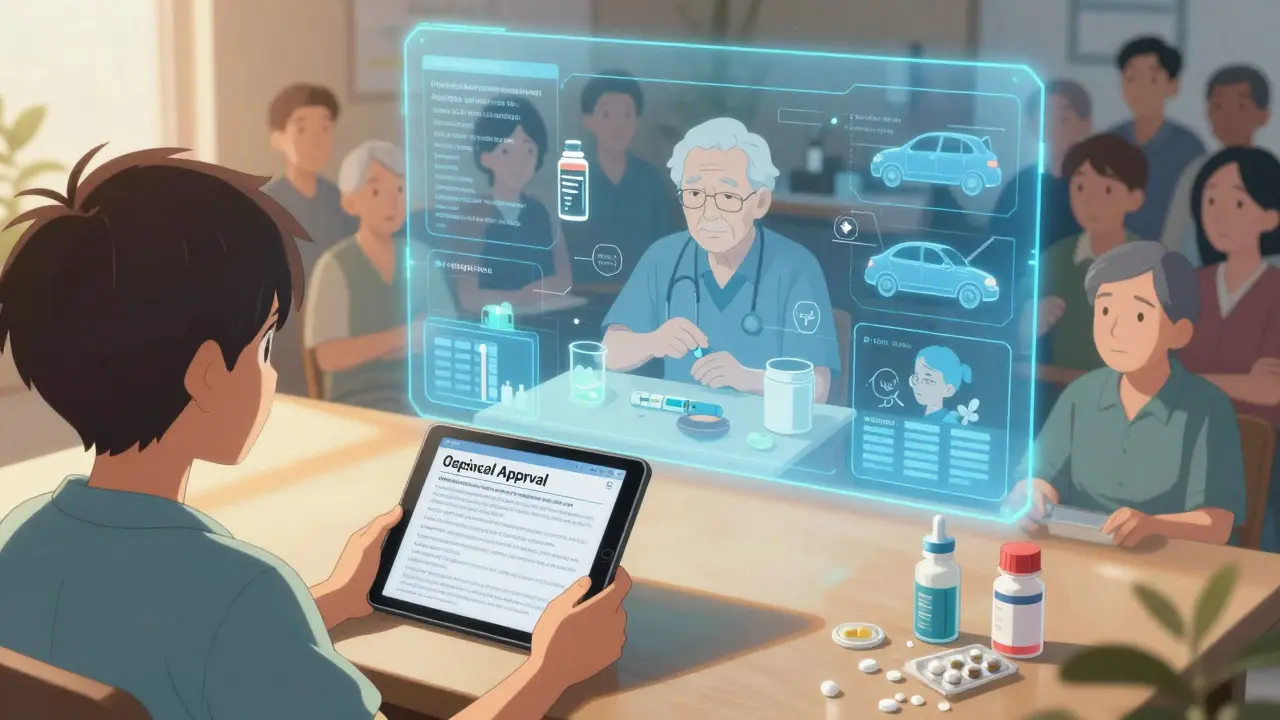
Where the Two Worlds Work Together
The future isn’t clinical trials or real-world data. It’s both. Companies like Flatiron Health spent five years and $175 million building a database of 2.5 million cancer patients’ electronic records. That data didn’t replace trials-it improved them. By analyzing patterns in real-world outcomes, researchers could predict which patients were most likely to stick with a treatment. That allowed them to design smaller, faster trials with higher success rates. One study showed this “predictive enrichment” cut required sample sizes by 20% without losing statistical power. AI is making this even smarter. Google Health’s 2023 study showed algorithms could predict how a patient would respond to a drug using only their EHR history-with 82% accuracy. That’s better than the 76% accuracy of traditional trial analysis. And hybrid trials are emerging. These designs start with a small RCT to confirm safety, then expand into real-world monitoring to track long-term effects. The FDA’s 2024 draft guidance encourages this approach. It’s not about replacing science. It’s about expanding it.Why This Matters to You
If you’re taking a new medication, the clinical trial data you hear about doesn’t tell you how it’ll work for you. It tells you how it worked for a selected group under ideal conditions. Real-world outcomes show you what happens when real people-people with jobs, bills, side effects, and complicated lives-take that same drug. That’s why doctors are starting to ask: “Did this work for someone like you?” Instead of: “Did this work in the trial?” The next time you hear about a breakthrough drug, look beyond the headlines. Ask: Who was in the trial? Who was left out? And what do people who’ve been on it for six months actually say? Real-world evidence doesn’t undermine clinical trials. It completes them. Together, they give us the full picture: not just whether a drug works-but whether it works for people like us.Can real-world data replace clinical trials?
No. Clinical trials are still the gold standard for proving a drug’s safety and initial effectiveness under controlled conditions. Real-world data can’t replace that rigor. But it can show whether the drug works in everyday practice, where patients have other health issues, take multiple medications, or can’t always follow the exact dosing schedule. The two are complementary, not interchangeable.
Why are clinical trial participants so different from real patients?
Clinical trials exclude people with other medical conditions, older adults, pregnant women, and those from underserved communities to reduce variables and get a clear signal of the drug’s effect. But this means the trial group is healthier and more privileged than the general population. A 2023 study found only 20% of cancer patients in clinics qualified for trials, with Black patients excluded at higher rates due to access barriers-not medical reasons.
How reliable is real-world evidence?
It can be very reliable-if the data is high-quality and analyzed properly. But real-world data is messy. Missing records, inconsistent coding, and unmeasured factors like income or medication adherence can create bias. Studies show only 39% of RWE findings could be replicated in 2019. That’s why regulators now require strict data quality assessments before accepting RWE for decision-making.
Which therapeutic areas use real-world evidence the most?
Oncology leads the way, with 45% of real-world studies, because cancer drugs are expensive and placebo trials are unethical. Rare diseases are next at 22%, since small patient populations make traditional trials impractical. Chronic conditions like diabetes and heart disease are catching up as insurers demand proof of long-term value before paying for expensive treatments.
Why do payers care about real-world outcomes?
Because they pay for the drugs. If a medication works in a trial but fails in practice-because patients can’t afford it, forget to take it, or have bad side effects-payers lose money. A 2022 survey found 78% of U.S. insurers now use real-world evidence to decide whether to cover new drugs. They want proof it works for real people, not just trial participants.
Is real-world evidence faster and cheaper than clinical trials?
Yes. Clinical trials take 24-36 months and cost $19 million on average. Real-world studies can be done in 6-12 months at 60-75% lower cost because they use existing data from electronic records and insurance claims. But they require advanced analytics and data linkage skills-only 35% of healthcare organizations have dedicated teams to handle it.

Write a comment
Your email address will not be published.
Recent Posts
-
 Hepatorenal Syndrome: How Liver Failure Causes Sudden Kidney Shutdown December 25, 2025
 -
 How and Where to Buy Sildenafil Online Safely in 2026 July 27, 2026
 -
 Montelukast: Tackling Asthma-Related Fatigue Effectively March 11, 2025


11 Comments
So let me get this straight - we spend billions to test drugs on people who don’t represent anyone in the real world, then act shocked when the drug fails on actual humans? Classic. We’re running a science fiction movie where the protagonist is a 28-year-old white male with zero comorbidities and a personal trainer. Meanwhile, the rest of us are just background extras with diabetes, jobs, and no insurance. 😒
Real-world data isn't a replacement for RCTs it's a complement. The key is methodological rigor in both. Poorly analyzed RWE introduces bias just as easily as poorly designed trials. We need standardized data pipelines and transparent analytical frameworks not just more data.
I had a cousin on that new lung cancer drug. She was 72, had COPD, and missed two doses because her grandson got sick and she had to take care of him. The trial said 87% survival at 12 months. She lasted 5 months. They never asked how she was actually living. They just recorded her vitals and moved on. This isn't science. It's a fantasy.
Look man… RWE is just observational data with a fancy acronym. It’s not evidence it’s noise. You can’t control for confounders without randomization. The FDA’s getting lazy. This is the same logic that got us Vioxx and fen-phen. We’re trading rigor for speed and pretending it’s innovation. 🤷♂️
Of course the trials exclude the poor. The entire pharma industry is built on selling hope to people who can’t afford it. They test on the privileged so they can charge the unprivileged $100K/year. The real scandal isn’t the data gap - it’s the profit motive. And don’t even get me started on how they cherry-pick endpoints. This isn’t medicine. It’s capitalism with a stethoscope.
Let’s be honest: the entire clinical trial system is a corporate propaganda tool. The FDA is a regulatory puppet. The trials are designed to fail only the poor, the elderly, and the non-white. The real reason they exclude comorbidities? Because they don’t want to know if the drug kills people with kidney disease. That would hurt sales. This isn’t science - it’s a cover-up.
trials r just marketing tools. real world data? yeah its messy but its real. stop pretending we need perfect data to save lives. we need real info. not lab rats in suits.
And yet… nobody talks about how the data is collected… the missing values… the inconsistent ICD codes… the patients who never show up… the pharmacy records that don’t match the EHR… the fact that 60% of real-world patients don’t even take their meds as prescribed… and we’re supposed to trust this? This isn’t evidence - it’s a statistical minefield… with a glittery label.
Let’s not pretend this is about patient care. It’s about $$$ and speed. Pharma wants to cut costs. Regulators want to look proactive. Insurers want to deny claims. Real-world data is the perfect excuse to skip real science. And AI? Don’t get me started. Algorithms trained on biased data just reinforce the bias. We’re automating inequality. This isn’t progress - it’s a trap.
the whole system is rigged and nobody wants to admit it. trials are for rich people. real world data is for the rest of us. and the fda just rubber stamps whatever pharma gives them. why do you think they approved 17 drugs on rwe in 4 years? because they can’t afford to do real trials anymore. we’re just guinea pigs now.
Finally, someone is talking sense! 🙌 Real-world data isn’t perfect - but neither is pretending a 25-year-old marathon runner represents your 68-year-old grandma with three chronic conditions. Let’s stop romanticizing trials and start honoring lived experience. The future of medicine isn’t in labs - it’s in clinics, kitchens, and living rooms. 💪❤️