
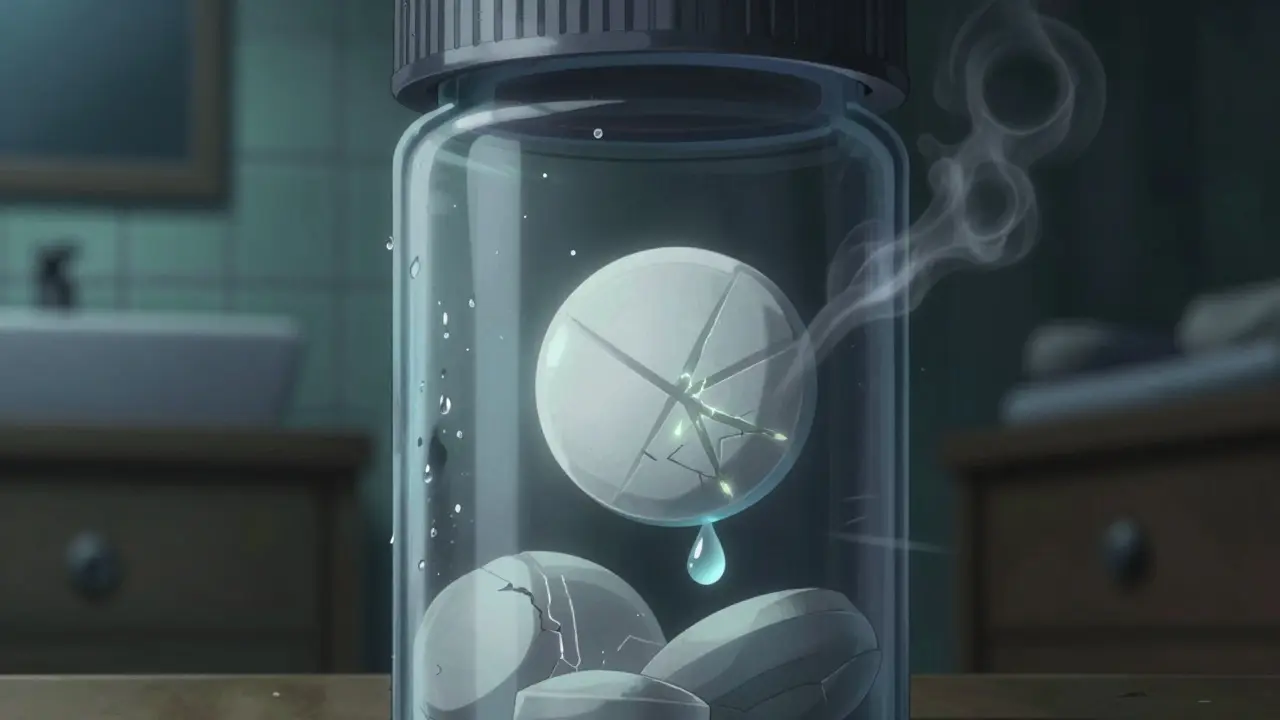
Moisture is one of the biggest silent killers of medications. You might not realize it, but every time you open a pill bottle, you’re letting in humid air - and that air can slowly destroy the drugs inside. In humid climates like Manchester, where damp weather is common, even properly sealed bottles can become a breeding ground for degradation. The result? Pills that lose potency, capsules that stick together, or worse - chemicals that break down into harmful substances.
Take aspirin, for example. When it gets wet, it turns into salicylic acid and vinegar. That doesn’t just make it less effective - it can irritate your stomach. Vitamin C tablets? They oxidize fast when moisture gets in. Antibiotics like amoxicillin/clavulanic acid? They can completely lose their strength in as little as 10 days if not protected. And when medication fails, people don’t just feel worse - they end up back in the hospital.
Why Moisture Destroys Pills and Capsules
Medicines aren’t just chemicals floating in air. They’re precise formulas designed to work at exact doses. Moisture triggers two main problems: hydrolysis and oxidation. Hydrolysis is when water molecules break chemical bonds - think of it like water rusting metal, but inside your pill. Oxidation is when oxygen reacts with the drug, especially when moisture is around to speed things up. Both processes change the chemical structure of the active ingredient.
Manufacturers test this using something called loss on drying (LOD). It measures how much water a tablet absorbs over time. A tablet that starts at 3.1% moisture and climbs to 4.5% might still look fine - but its effectiveness could have dropped by 30%. That’s not a small difference. That’s the difference between healing you and doing nothing.
And it’s not just about the bottle. Once you transfer pills to a pill organizer, a ziplock bag, or even a purse, you’re removing the factory seal. Each time you open the container, you introduce new moisture. In a standard 500-pill bottle taken twice daily, you’ll open it roughly 250 times over its lifespan. That’s 250 chances for humid air to sneak in.
The Three Layers of Moisture Protection
The best way to stop moisture damage isn’t one trick - it’s three layers working together. Think of it like waterproofing a house: you need a good roof, sealed windows, and a dehumidifier inside.
- Layer 1: Film Coating - This is the first line of defense, built into the pill itself. Most pills have a thin outer layer. Older coatings use HPMC (hydroxypropyl methylcellulose), which is okay but not great. Newer coatings use PVA (polyvinyl alcohol), like Opadry® amb II. Studies show PVA coatings block moisture up to 40% better than HPMC. In one test, uncoated and HPMC-coated amoxicillin tablets lost all their clavulanic acid after 10 days outside the bottle. PVA-coated ones? Still fully potent. This isn’t marketing - it’s science.
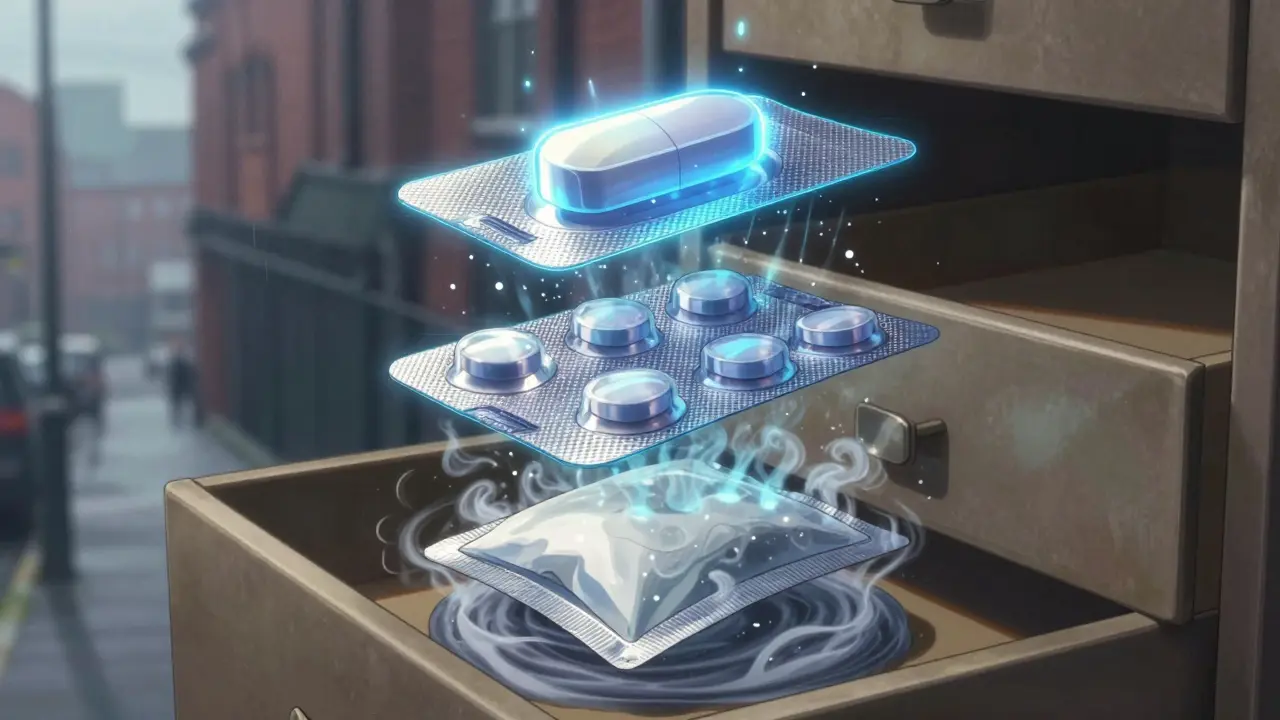
- Layer 2: Packaging - HDPE bottles (the common plastic ones) are cheap and sturdy, but they let water vapor creep through over time. Aluminum blisters or foil-lined pouches block moisture much better. But even those aren’t enough on their own. The best packaging combines a tight seal with a moisture-absorbing layer inside.
- Layer 3: Desiccants - This is the hidden hero. Silica gel packs - those little white or blue beads you find in pill bottles - are designed to soak up moisture like a sponge. A single pack can absorb up to 40% of its own weight in water. In long-term testing, adding the right-sized silica gel pack kept moisture levels in a bottle from rising more than 0.3% over two years. Without it? The same bottle saw a 1.5% jump in just six months.
The real win? When all three layers are used together. A PVA-coated tablet in an aluminum blister pack with a properly sized silica gel pack can survive humidity levels that would destroy any single-layer solution.
What You Can Do as a Patient
You don’t need to be a pharmacist to protect your meds. Here’s what actually works:
- Keep pills in their original bottle. Don’t dump them into a pill organizer unless you’re using it for the day. Even then, refill it daily - don’t pre-fill for a week.
- Never store pills in the bathroom. Steam from showers, sinks, and baths creates constant humidity. A bedroom drawer or kitchen cabinet away from the sink is far better.
- Check for desiccants. If your bottle doesn’t have a silica gel pack, ask your pharmacist. Most pharmacies now include them for moisture-sensitive drugs. If they don’t, request them. They’re cheap, safe, and effective.
- Don’t reuse bottles. If you refill an old bottle from a different medication, you’re risking cross-contamination - and moisture buildup from previous contents.
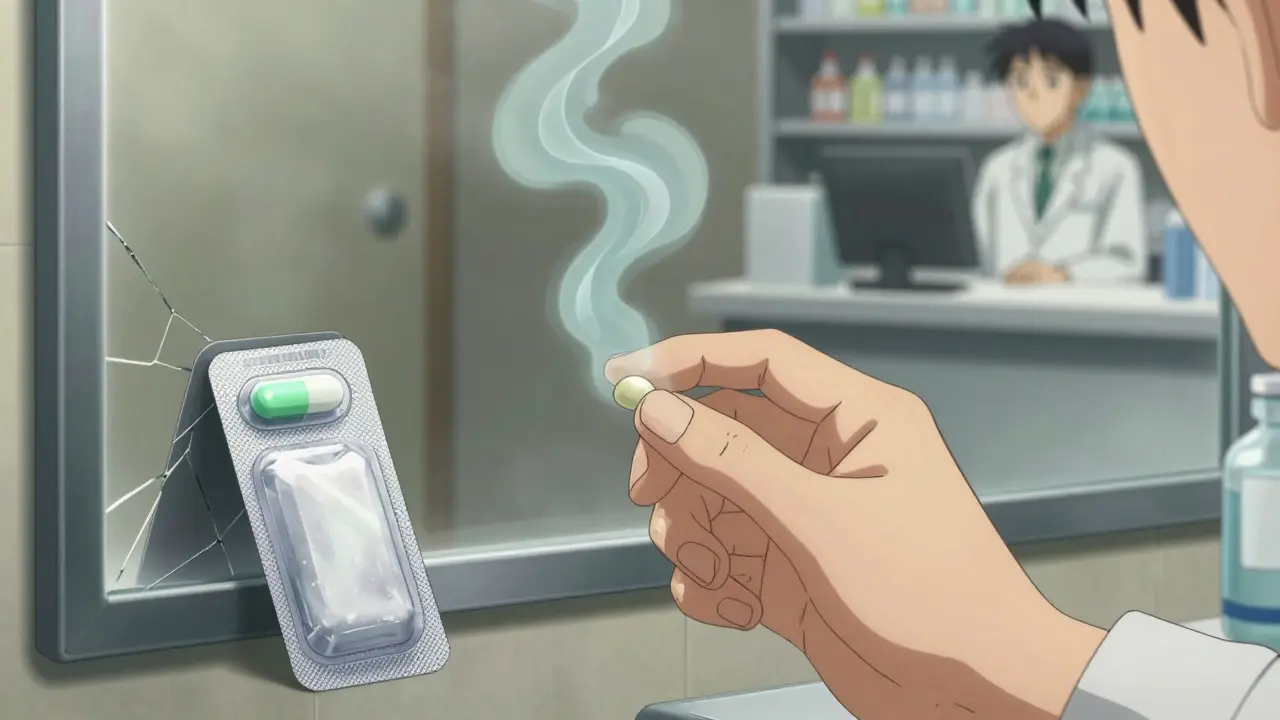
- Watch for signs of damage. If pills are sticky, discolored, cracked, or smell odd (like vinegar), don’t take them. Return them to the pharmacy. Degraded meds aren’t just useless - they can be dangerous.
What Manufacturers Should Do
For drugmakers, the cost of moisture damage isn’t just lost pills - it’s recalls, lawsuits, and broken trust. The FDA and EMA require proof that packaging protects drugs over their full shelf life. Many companies still cut corners.
Here’s what works:
- Use PVA-based coatings instead of HPMC for moisture-sensitive drugs like antibiotics, vitamins, and hormones.
- Always include a properly sized desiccant. A 500-pill bottle needs a pack that can absorb at least 150% of the expected moisture from 250 openings.
- Use foil blister packs for high-risk drugs. They’re more expensive, but they reduce returns by over 70% in humid markets.
- Test stability under real-world conditions. Lab tests at 25°C and 60% humidity aren’t enough. Test at 30°C and 75% - that’s what patients experience in summer.
One company in Brazil switched from HDPE bottles to foil blisters with silica gel after 12% of their products were returned due to degradation. Within six months, returns dropped to 0.3%. That’s not just savings - that’s customer trust rebuilt.
Common Mistakes and How to Avoid Them
Here’s what goes wrong - and how to fix it:
- Mistake: Using too small a desiccant. Solution: Calculate headspace. A 500-pill bottle has about 300ml of empty space. Multiply that by 250 openings. You need a desiccant that can handle at least 150% of that moisture load.
- Mistake: Thinking plastic is enough. Solution: HDPE lets moisture through. Use foil, glass, or aluminum-lined containers for long-term storage.
- Mistake: Ignoring climate. Solution: If you live in a humid area (like Manchester, Florida, or Singapore), demand better packaging. Ask your pharmacist: “Is this drug moisture-sensitive? Does it have a desiccant?”
- Mistake: Assuming all coatings are the same. Solution: Ask if your meds use PVA-based coatings. Brands like Opadry® amb II are proven. If you don’t know, check the manufacturer’s website or call them.
What the Future Holds
Pharmaceutical companies are already working on smarter solutions. Some are developing packaging with color-changing labels that turn blue when moisture gets in. Others are testing moisture-absorbing materials built directly into the pill coating. Imagine a tablet that pulls in humidity before it can damage the core - that’s the next step.
Right now, the most reliable solution is simple: coating + packaging + desiccant. It’s not fancy. But it’s been proven in labs, in clinics, and in real homes across the world.
Can I reuse the silica gel pack from my pill bottle?
No. Once silica gel has absorbed moisture, it’s saturated. Reusing it won’t help - and if it’s been exposed to air for more than a few hours, it’s already lost most of its capacity. Always use fresh desiccants provided with new medication. If you’re storing pills long-term, buy new packs separately - they’re inexpensive and sold in bulk.
Are all pill coatings the same?
No. Older coatings like HPMC (hydroxypropyl methylcellulose) offer basic protection but are porous to moisture. Newer PVA-based coatings like Opadry® amb II are specifically engineered to block water vapor. If your medication is moisture-sensitive (like antibiotics, vitamin C, or insulin tablets), ask your pharmacist if it uses PVA coating. It’s worth asking - and worth paying a little more for.
Why do some pill bottles have desiccants and others don’t?
It depends on the drug and the manufacturer. Medications that are highly hygroscopic - meaning they attract water - like tetracycline, vitamin C, or certain antibiotics, almost always include desiccants. Cheaper generic brands sometimes skip them to cut costs. If your bottle doesn’t have one and you live in a humid area, ask your pharmacist to switch to a version that does. Many pharmacies can order them.
Can I store pills in the fridge to keep them dry?
No. Refrigerators are humid environments. Condensation forms when you take cold pills out into warm air, and that moisture can settle on the surface and seep into the pill. Unless the label says "store in the refrigerator," keep pills at room temperature in a dry place - like a drawer in your bedroom.
How do I know if my pills have been damaged by moisture?
Look for these signs: pills that are sticky, discolored (yellow, brown, or faded), cracked, or have an odd smell (like vinegar). Capsules that stick together or are hard to swallow may also be degraded. If you see any of these, don’t take them. Take them back to your pharmacy. They’ll replace them - and they’ll know if it’s a batch issue.
If you’re worried about your medication’s effectiveness, the safest move is simple: talk to your pharmacist. They see this every day. They know which drugs are sensitive. They know which brands use better coatings. And they can help you choose the right packaging - whether you’re at home, traveling, or living in a humid climate. Your health isn’t worth guessing.

Write a comment
Your email address will not be published.
Recent Posts
-
 Viramune (Nevirapine) vs. Other HIV Drugs: 2025 Comparison Guide October 6, 2025
 -
 Mindful Eating: How to Stop Emotional and Binge Eating for Good December 23, 2025

8 Comments
Been using PVA-coated pills for my antibiotics since I moved to Florida, and honestly? No more weird stickiness or chalky taste anymore. The difference is night and day. I didn’t even know coatings mattered until my pharmacist explained it. Now I check the bottle before I buy. Simple habit, huge payoff.
Also, never thought about how many times you open a bottle. 250 openings? That’s wild. No wonder stuff degrades. I’ve started keeping mine in a sealed plastic container with a silica pack in my drawer. Feels like a small upgrade with big consequences.
So basically, we’re being sold snake oil unless we pay extra for ‘PVA-coated’ or ‘foil blister’ packaging? Classic. Big Pharma doesn’t care if your aspirin turns into vinegar as long as you keep buying new bottles. They’d rather you get sick and come back than save you money upfront.
Also, silica gel packs? I’ve reused them for my electronics. Still works fine. Why throw them out? Seems like a scam to sell more packs.
It is imperative to underscore that the hydrolytic degradation of pharmaceutical agents is a function of both thermodynamic water activity and kinetic diffusion rates through polymeric matrices. The assertion that HPMC coatings are ‘okay but not great’ is empirically reductive; studies from the Journal of Pharmaceutical Sciences (2021) demonstrate that coating efficacy is contingent upon molecular weight distribution and plasticizer content, not merely polymer class.
Furthermore, the claim that silica gel packs absorb 40% of their weight is misleading without reference to relative humidity thresholds. At 75% RH, desiccant capacity plummets by 68%. This article, while well-intentioned, lacks rigorous calibration of environmental variables. It is, frankly, amateurish.
You’re risking your life by ignoring this. If your pills look funny, throw them out. No excuses. No ‘maybe it’s fine.’ That’s how people end up in the ICU. Your laziness isn’t a lifestyle choice-it’s a public health hazard.
USA makes the best meds. If you’re in the UK or wherever and your pills are crumbling, maybe stop complaining and move here 🇺🇸🔥
I used to toss the silica packs. Then I started saving them in a jar with my extra vitamins. Now I drop one in my travel pill case. No more sticky tabs on humid trips. It’s dumb simple, but it works.
Also, fridge = bad. Learned that the hard way after my insulin got weird. Room temp drawer, dry as a bone. Best advice I got from my pharmacist.
Let’s be real - most people don’t care about PVA vs HPMC. They just want their meds to work. But here’s the kicker: if you’re on a chronic med like doxycycline or vitamin C, this shit matters. I work in logistics for a regional pharmacy chain. We used to get 8-10 returns a week from humid states for ‘expired’ meds that were only 3 months old.
Then we switched to foil blister + silica + PVA coating on high-risk items. Returns dropped to 1 per month. The math doesn’t lie. It’s not marketing. It’s chemistry. And yeah, it costs a little more - but not as much as a hospital visit.
Also, ‘don’t store in bathroom’ - I get it. But what if you’re 72, live alone, and the bathroom is the only cabinet with a lock? We need solutions for real life, not textbook ideals.
Biggest takeaway? Talk to your pharmacist. Not Google. Not Reddit. Them.
I asked mine if my generic metformin had PVA coating. She said no, but she had a branded version with it for $2 more. I took it. No more nausea. No more weird texture. She said it’s not about the active ingredient - it’s about how it’s delivered.
Also, silica gel packs? I buy them in bulk online. Keep one in every pill container I own. Costs less than a coffee. Worth it.
And yeah, bathroom = bad. But if you’re in a tiny apartment with no drawer space? Get a dry box. They’re like little dehumidifiers for meds. $30 on Amazon. Game changer.