
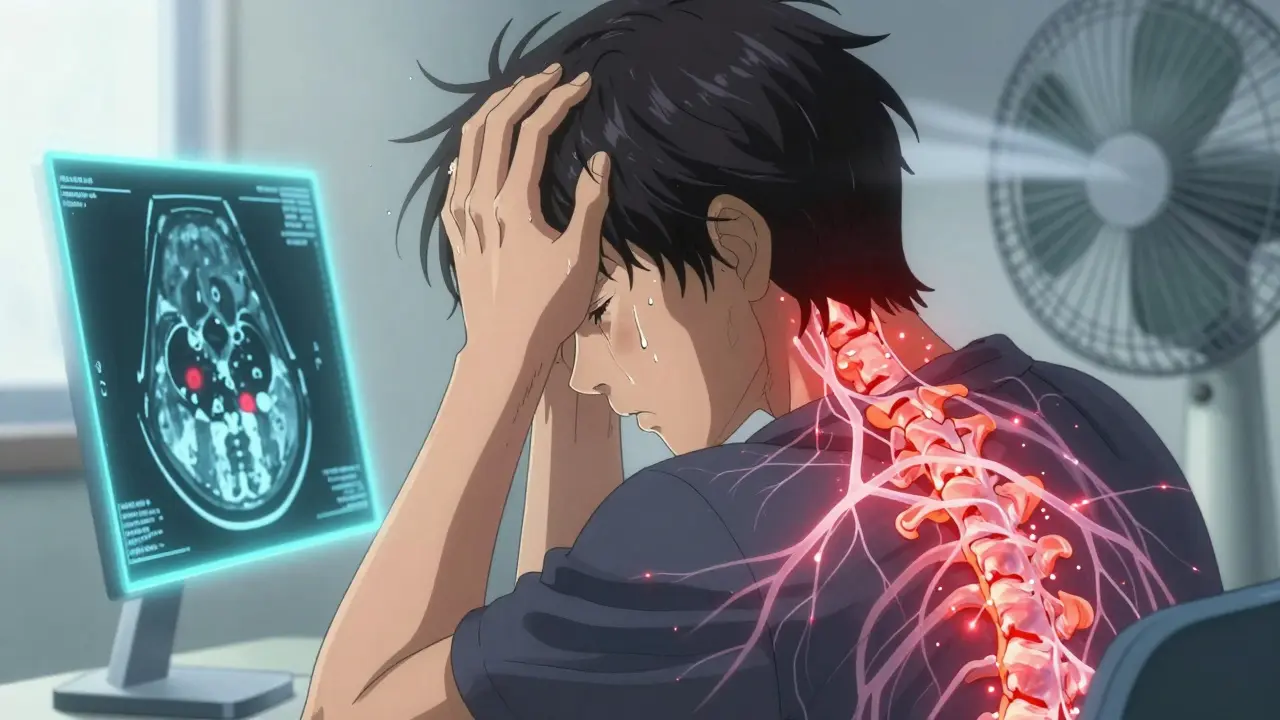
When someone with multiple sclerosis experiences a sudden worsening of symptoms-like blurred vision, leg weakness, or numbness-it’s natural to panic. Is this a relapse? Or is it just a pseudorelapse? The difference matters more than you think. One might need steroids. The other doesn’t. And giving steroids when they’re not needed can cause real harm.
What’s a True MS Relapse?
A true MS relapse isn’t just feeling worse for a day. It’s a new flare-up of neurological symptoms-or a serious worsening of old ones-that lasts at least 24 to 48 hours and isn’t tied to anything else going on in your body. No fever. No infection. No heat. Just your immune system attacking myelin in your brain or spinal cord, causing new damage.This is inflammation. This is demyelination. This is active disease. MRI scans during a true relapse will often show new lesions or areas where the blood-brain barrier is leaking-signs your immune system is actively breaking down nerve insulation.
Common symptoms include sudden weakness in one limb, trouble walking, vision loss in one eye, or loss of bladder control. These don’t come and go with the weather. They stick around. And they can leave behind lasting damage. Studies show that about 45-55% of people don’t fully recover from a true relapse, even with treatment.
What’s a Pseudorelapse?
A pseudorelapse (also called a pseudoexacerbation) looks just like a relapse. Same symptoms. Same intensity. But here’s the key: no new damage. No inflammation. No new lesions on MRI. Your nerves are just temporarily struggling to send signals because something outside your nervous system is interfering.Think of it like a frayed electrical wire. The wire is already damaged from past MS attacks. Now, when you turn up the heat, the signal gets weaker. It’s not a new break-it’s just a temporary glitch.
Pseudorelapses are surprisingly common. Around 15-25% of all symptom flares in MS are pseudorelapses. For older patients or those with longer disease duration, that number jumps even higher. The most common triggers?
- Urinary tract infections (UTIs) - the #1 trigger, responsible for 67% of cases
- Heat - hot showers, summer weather, even a fever can do it
- Fever - even a low-grade fever from a cold or flu
- Stress - emotional or physical
- Physical overexertion - pushing too hard at the gym or doing too much housework
Uhthoff’s phenomenon is a classic example. If you’ve had optic neuritis before, your vision might blur or darken when your body temperature rises-even from a warm bath. It’s not new MS. It’s your damaged optic nerve temporarily losing signal strength because of heat. Cool down, and your vision comes back-usually within hours.
Steroids: When They Help and When They Don’t
High-dose IV methylprednisolone (1 gram daily for 3-5 days) is the standard treatment for true relapses. It works by calming inflammation, speeding up recovery, and reducing long-term disability.Studies show that 70-80% of people with true relapses feel better faster with steroids. But here’s the catch: steroids don’t fix pseudorelapses. Why? Because there’s no inflammation to stop.
When steroids are given for a pseudorelapse, you’re not treating the cause-you’re just exposing yourself to side effects:
- High blood sugar - happens in 25% of patients
- Insomnia - up to 40%
- Mood swings or anxiety - around 30%
- Increased infection risk - especially dangerous if you’re already fighting a UTI
- Even psychosis - rare, but documented in cases like a nurse on Reddit who saw patients hospitalized after unnecessary steroid use
Research from Neurology.org estimates that 30-40% of pseudorelapses are wrongly treated with steroids. That’s not just unnecessary-it’s risky. The National MS Society says this mismanagement costs the U.S. healthcare system over $12 million a year.
How Doctors Tell the Difference
It’s not always easy. Many patients don’t realize their symptoms are triggered by heat or a UTI. Even some doctors miss it.The gold standard is a three-step check:
- Duration - Did symptoms last longer than 24-48 hours?
- Triggers - Was there a fever? A recent infection? A heat wave? A stressful event?
- Testing - A urinalysis for UTIs, a temperature check, and a basic blood panel to rule out metabolic issues (like low sodium).
If triggers are found and symptoms improve once they’re gone, it’s a pseudorelapse. No steroids needed.
If no triggers are found, symptoms persist, and you have new neurological signs? Then an MRI is the next step. New lesions? That’s a true relapse.
Neurologists who specialize in MS get it right 85% of the time. General neurologists? About 60%. Primary care doctors? Only 45%. That’s why MS patients are often told to keep a symptom diary-recording temperature, infections, stress levels, and activity changes. It helps your doctor spot patterns.
Who’s Most at Risk for Pseudorelapses?
You’re more likely to have a pseudorelapse if:- You’ve had MS for 10+ years
- You’re over 55
- You already have significant disability (like trouble walking or bladder issues)
- You’ve had optic neuritis before (Uhthoff’s phenomenon)
Why? Because over time, MS damages more nerves. The ones that are left are already working at their limit. Any extra stress-heat, infection, fatigue-pushes them over the edge. But again: no new damage. Just temporary overload.
One study found that 15% of patients over 55 didn’t fully return to their baseline function after a pseudorelapse-not because of MS progression, but because of deconditioning. If you’re stuck in bed for days because you think you’re having a relapse, you lose strength. That takes time to rebuild.
Real Stories: What Patients Say
On MS support forums, the stories are powerful:- “I thought my leg weakness was a relapse. Turns out, I had a UTI. Once I took antibiotics, I was walking normally in 48 hours. No steroids.” - MyMSTeam user
- “I got IV steroids for ‘relapse’ after a hot day. Felt worse. Developed insomnia and anxiety. My neurologist later said it was Uhthoff’s. I use cooling vests now. No more meds.” - MSWarrior2020
- “As a nurse with MS, I’ve seen five patients get unnecessary steroids for UTIs. One went into steroid-induced psychosis. It was preventable.” - Reddit user NeuroNurse87
These aren’t rare cases. They’re common. And they’re preventable.
New Tools Helping Patients and Doctors
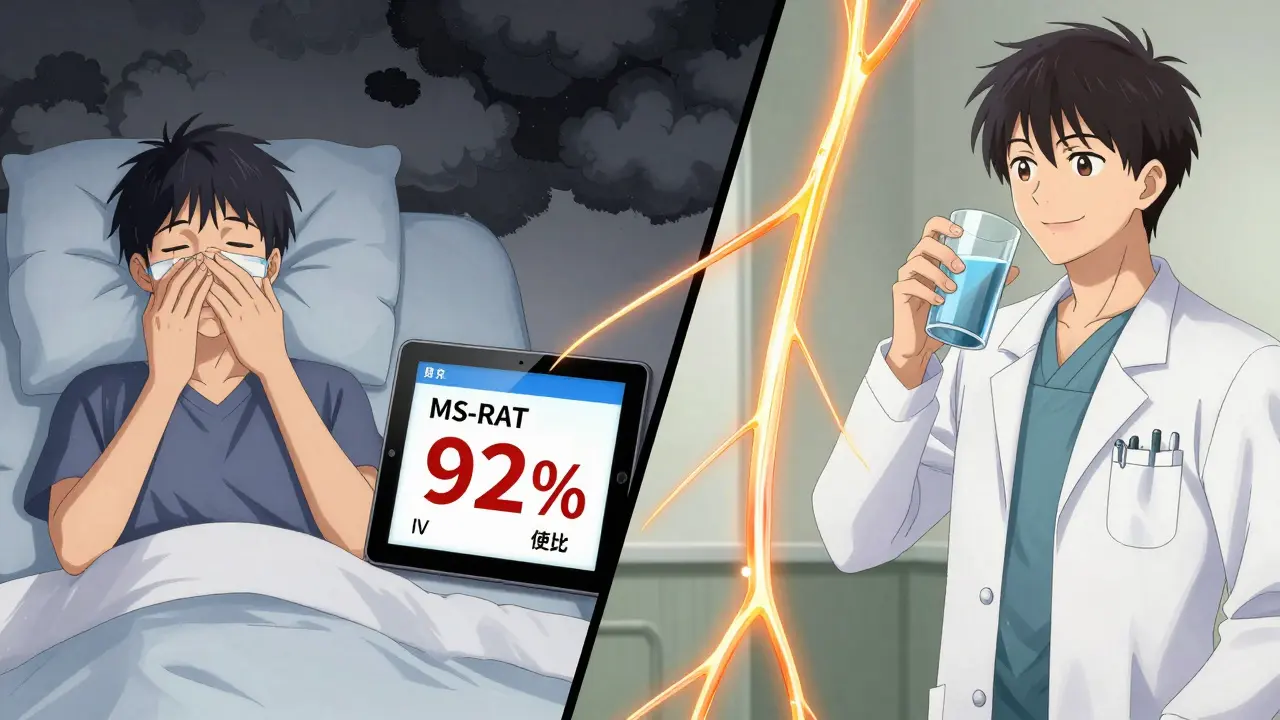
The field is catching up. In 2023, the MS-Relapse Assessment Tool (MS-RAT) was validated. It uses three things:- How long symptoms lasted
- Body temperature
- Functional impact score
It gives a probability score-92% sensitive, 88% specific-for whether it’s a true relapse or pseudorelapse. Telemedicine platforms like MS Selfie are also helping patients take photos or videos of symptoms and send them to specialists for remote assessment.
Future research is looking at blood tests that measure neurofilament light chain-a protein released when nerves are damaged. If levels are high, it suggests active inflammation. If they’re normal? Likely a pseudorelapse.
What You Should Do
If you feel a flare-up:- Don’t assume it’s a relapse. Check for triggers first.
- Check your temperature. Is it above 100°F?
- Look for signs of infection. Burning when you pee? Cough? Fever?
- Did you just take a hot shower? Walk outside in 90°F heat? Run a marathon? Cool down. Rest. Wait 24 hours.
- Keep a diary. Write down what you were doing, how you felt, and what changed.
- Call your neurologist before starting steroids. Don’t self-treat.
Pseudorelapses don’t mean your MS is getting worse. They mean your body is under stress. And once you fix the trigger, you’ll likely bounce back-no steroids, no hospital visits, no side effects.
True relapses do need treatment. But you can’t treat what you don’t understand. Knowing the difference isn’t just helpful-it’s life-changing.
Can a pseudorelapse turn into a true relapse?
No. A pseudorelapse is not a sign that MS is progressing. It’s a temporary symptom flare caused by an external trigger. Once the trigger is removed, symptoms go away without causing new nerve damage. However, if you have an untreated infection or prolonged heat exposure, it can stress your nervous system and make you more vulnerable to a true relapse later-but the pseudorelapse itself doesn’t cause it.
Do I need an MRI every time I have symptoms?
Not usually. MRIs are most helpful when triggers are ruled out and symptoms last longer than 48 hours with no clear cause. If you have a fever or UTI and symptoms improve after treatment, an MRI isn’t needed. But if symptoms persist, worsen, or are new (like sudden vision loss or paralysis), an MRI helps confirm whether there’s new inflammation.
Are steroids ever used for pseudorelapses?
Rarely, and only in extreme cases-like if a patient is severely disabled and the trigger can’t be immediately fixed (e.g., a hospital-bound patient with a UTI who can’t be treated right away). But even then, steroids are not the first choice. The goal is always to treat the trigger, not the symptom. Using steroids without a clear inflammatory cause does more harm than good.
Why do heat and stress trigger pseudorelapses?
MS damages the myelin that protects nerve fibers. These damaged nerves already struggle to send signals. Heat slows down electrical impulses even more-like a frayed wire getting weaker when it overheats. Stress triggers hormones like cortisol that can temporarily disrupt nerve signaling. Neither causes new damage, but both make existing damage worse-just temporarily.
How can I prevent pseudorelapses?
Stay cool: Use cooling vests, avoid hot tubs, and limit time in hot weather. Prevent infections: Get flu shots, drink water, and treat UTIs early. Manage stress: Practice breathing, yoga, or mindfulness. Avoid overexertion: Pace yourself. Keep a symptom diary so you spot your personal triggers. Most pseudorelapses are preventable with simple, consistent habits.

Write a comment
Your email address will not be published.
Recent Posts
-
 Recent Patent Cases and Generic Delays: 2023-2025 Examples December 19, 2025
 -
 Ornithine Alpha‑Ketoglutarate: Boost Muscle, Hormones & Recovery September 21, 2025
 -
 Super Avana vs Alternatives: Dapoxetine and Avanafil Compared November 18, 2025

15 Comments
This is one of the clearest breakdowns I’ve ever read on pseudorelapses vs. true relapses. 🙌 Seriously, if you’re new to MS or just confused about why your symptoms flared, read this twice. I used to panic every time I got warm - now I just grab my cooling vest and chill. Literally. 😎
OMG!! I CAN’T BELIEVE HOW MANY PEOPLE ARE GETTING UNNECESSARY STEROIDS!! THIS IS A NATIONAL DISASTER!! 🚨💥 Every time someone says ‘I had a relapse’ and gets IV steroids, a baby unicorn cries. And no, I’m not exaggerating - I’ve seen it. My cousin got hospitalized because they gave her methylprednisolone for a UTI-induced pseudoflare. She had NIGHTMARES for WEEKS. Someone needs to sue the entire medical system. #MSWarrior
The distinction between relapse and pseudorelapse is fundamental. It’s not just about avoiding side effects - it’s about preserving trust in the treatment process. When patients are unnecessarily exposed to steroids, they begin to doubt their own bodies and their clinicians. That erosion of confidence can be more damaging than the disease itself.
I’ve had MS for 12 years. I used to think every twitch meant I was regressing. Then I started tracking my temps and UTI symptoms. Turns out? 7 out of 10 ‘flares’ were just heat or a bladder bug. Now I don’t even call my neuro unless it lasts 48+ hours. Game changer. Also - yes, cooling vests are life. I wear mine to the gym. People stare. I don’t care.
Good info. Stay cool. Watch for infections. Keep a diary. Simple stuff. But so many people overlook it. You don’t need a fancy MRI every time you feel off. Sometimes rest and water are the best medicine.
It’s fascinating how the nervous system’s fragility under stress mirrors broader biological principles - homeostasis, threshold dynamics, signal-to-noise ratios. The pseudorelapse isn’t a failure of the system; it’s a failure of context. We mistake transient signal degradation for structural collapse. That’s a cognitive error with clinical consequences. We need better frameworks for interpreting symptom variability.
I have to say, I'm absolutely floored by how under-discussed this issue is. I mean, if you think about it - the entire medical paradigm around MS exacerbations is built on a flawed assumption: that all worsening symptoms are inflammatory. But what if they're not? What if we're pathologizing normal physiological stress responses? And yet, here we are, giving high-dose steroids like they're candy. It's almost like we're afraid to say, 'Maybe your body just needs a break.'
I’m a nurse who’s seen this happen too many times. A patient comes in with leg weakness after a hot day. They’re terrified. We do the workup - no fever, no infection, normal labs. But the neurologist orders steroids anyway because ‘better safe than sorry.’ Spoiler: the patient got insomnia, mood swings, and a yeast infection. And the weakness? Gone in 18 hours after a cold shower. We need better education. For everyone.
I’ve been saying this for years. People think MS is this scary monster that’s always attacking. But half the time, it’s just your body going ‘I’m tired.’ You don’t need steroids. You need sleep. You need water. You need to stop running yourself into the ground. And if your doctor doesn’t get that? Find a new one.
I had a pseudorelapse last summer after hiking in 95°F. My legs gave out. I thought I was done. Called my neuro. They said ‘cool down, hydrate, wait 24.’ I did. Next morning? Back to normal. No steroids. No drama. Just me being dumb in the heat. 😅 Now I carry a mini fan everywhere. It’s my new bestie.
This whole ‘pseudorelapse’ thing? Sounds like Big Pharma’s way of keeping you docile. Why else would they push the ‘steroid solution’? They don’t want you to know that rest, hydration, and avoiding heat could fix 80% of your symptoms. And don’t get me started on how ‘MS-RAT’ is just another surveillance tool. They’re tracking your body temperature? That’s not medicine - that’s control.
Wow. So basically, if you’re not rich enough to afford a cooling vest or a private neurologist, you’re just gonna get pumped full of steroids and told to ‘tough it out.’ Classic. Meanwhile, the guy who lives in Arizona with no AC and a UTI gets labeled ‘non-compliant.’ Yeah. That’s fair.
I got steroids for a ‘relapse’ that was just a UTI. I was so angry. I lost 10 lbs from the side effects. My anxiety spiked. I had to quit my job. And guess what? My symptoms vanished in two days. No new lesions. No progression. Just a stupid infection. Now I’m terrified to even say ‘I feel off.’ What if they give me steroids again? I’m not a lab rat.
I think what’s most powerful here is the idea that healing doesn’t always mean fighting. Sometimes, healing means listening. Slowing down. Recognizing that your body isn’t broken - it’s overwhelmed. That shift in perspective? It changes everything. You stop seeing every symptom as a battle. You start seeing it as a signal.
The clinical implications of this distinction are profound. The current paradigm assumes a linear progression model - symptom increase = disease activity. But emerging evidence suggests a nonlinear, context-dependent model is more accurate. We must evolve our diagnostic criteria beyond MRI-centric paradigms and incorporate environmental, behavioral, and physiological variables into our assessments. This is not merely a matter of treatment efficacy - it is a matter of epistemological integrity in neurology.