
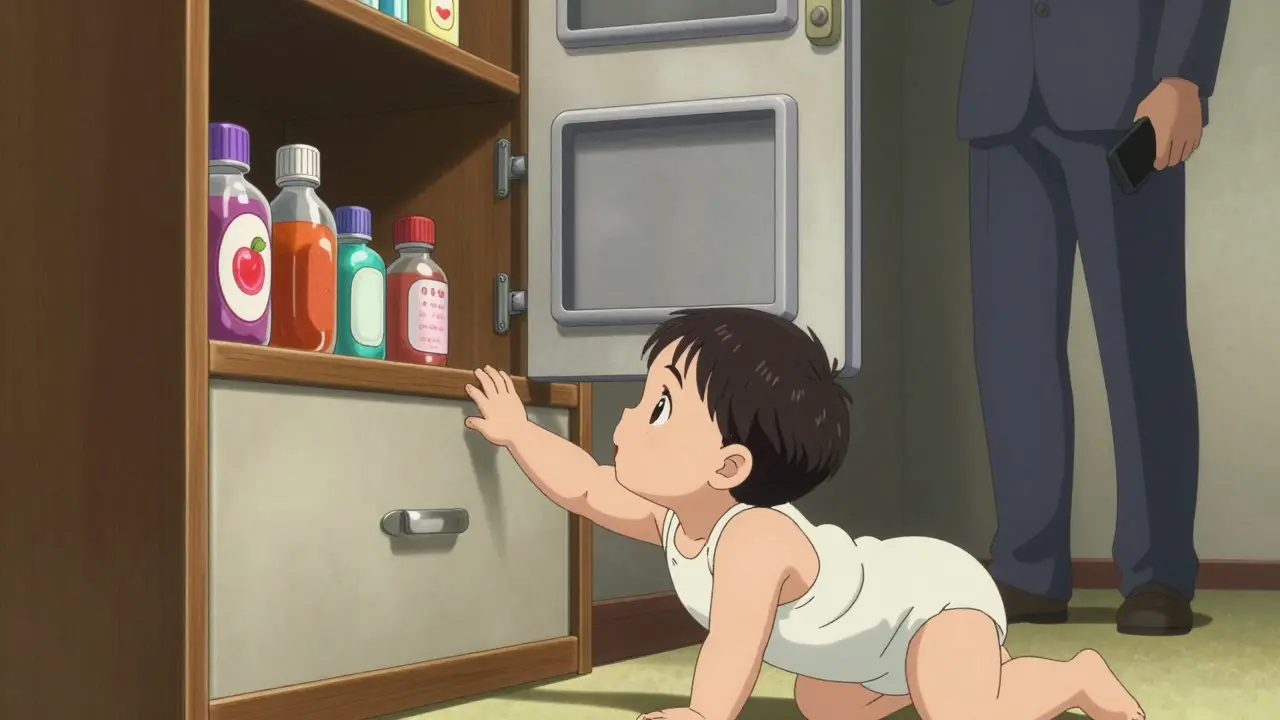
Most accidental poisonings happen right at home - and often while you're right there.
It’s not some rare tragedy that happens to other families. It’s a quiet, terrifying moment that can happen in seconds: a toddler pulls open a drawer, grabs a bottle, and swallows what looks like candy. Over 90% of these incidents happen in the home, according to Hassenfeld Children’s Hospital at NYU Langone Health. And in over half of those cases, the parent or caregiver was in the room. You weren’t distracted for long. You just turned your back for a moment to answer the phone, grab a towel, or check the oven. That’s all it takes.
Medicines aren’t candy - and saying they are makes it worse
It’s tempting. You want your child to take their medicine. So you say, “This is like candy,” or “It tastes sweet.” But research from the American Academy of Pediatrics shows this simple phrase increases the chance your child will take medicine on their own by 3.2 times. Kids don’t understand metaphor. To them, if it tastes good and you call it candy, it’s a treat. And they’re naturally drawn to anything that looks or smells like food. That’s why so many poisonings involve liquid acetaminophen, ibuprofen, or antihistamines - they’re often brightly colored and sweet-tasting. Never, ever call medicine candy. Ever.
Child-resistant doesn’t mean child-proof
You bought the bottle with the safety cap. You feel safe. But here’s the truth: child-resistant caps are designed to slow down a curious child, not stop them. A determined 18-month-old can figure out how to twist, press, or pry open most of them - especially if they’ve watched you do it a hundred times. The American Academy of Pediatrics, UCSF Benioff Children’s Hospital, and Nemours KidsHealth all agree: never rely on the cap alone. That’s like locking your car but leaving the key in the ignition. You need another layer.
Lock it up - not just up high
Storing medicine on the top shelf? That used to be good advice. But kids today are climbers. By 18 months, many can pull themselves up on furniture, climb onto the toilet, or use a chair to reach the counter. The Rural Health Information Hub found that 78% of poisonings happen with items stored below 4 feet - the average reach of a toddler. So where should you store it? Locked cabinets. Not just any cabinet. A cabinet with a magnetic lock or safety latch that automatically locks when closed. And it needs to be at least 54 inches off the floor. That’s higher than most toddler climbs can reach. Don’t just hide it - lock it. And make sure every cabinet in your home has one. That includes the bathroom, kitchen, bedroom, and even the guest room.
Never leave medicine in bags, purses, or coats
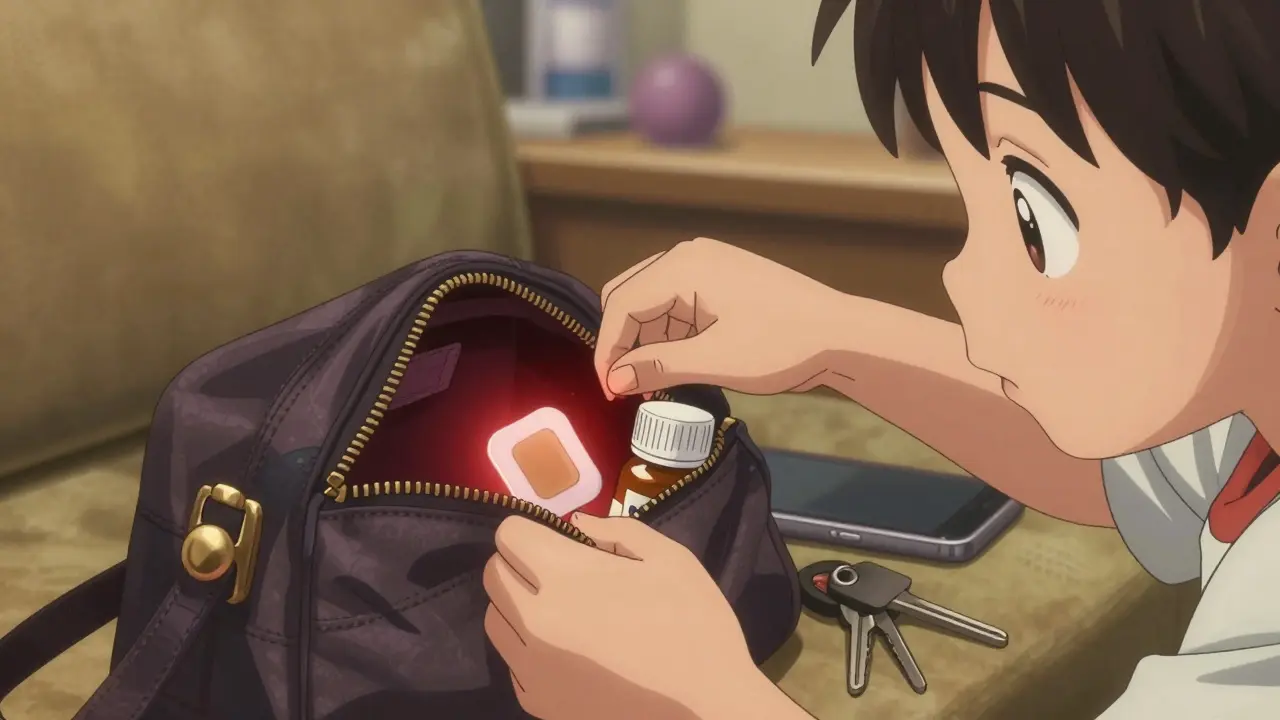
Visitors are a hidden risk. About 30% of all poisonings come from medications left in purses, coats, or bags. Grandparents, babysitters, or friends might leave their painkillers, sleep aids, or even nicotine patches in a bag on the couch. A child sees it, grabs it, and thinks it’s a toy. UCSF Benioff Children’s Hospital found households with frequent visitors have a 35% higher rate of accidental poisonings. Always ask guests: “Can you keep your medications in your car or in a locked drawer?” Keep a small, locked box near the front door for visitors’ meds. Make it normal. Make it safe.
Keep everything in original containers
Transferring pills or liquids into pill organizers, snack jars, or baby food containers sounds convenient. But it’s dangerous. Nationwide Children’s Hospital reports that 25% of poisoning cases involve medications taken out of their original packaging. Why? Because kids don’t know what’s inside. A blue capsule in a candy jar looks like a treat. A liquid in a water bottle looks like water. Always, always keep medicine in its original bottle with the label. That way, if something goes wrong, emergency responders can quickly identify what was taken - and how much.
Measure with care - never use kitchen spoons
Accidental overdoses are just as deadly as accidental ingestion. And they’re way more common than you think. Poison Control’s 2023 data shows that 68% of dosing errors happen because parents use kitchen spoons. A teaspoon isn’t a teaspoon. One household spoon might hold 3 mL. Another might hold 5 mL. That’s a 40% difference. Giving a child 5 mL of acetaminophen instead of 3 mL can cause liver damage. Always use the measuring tool that comes with the medicine - the syringe, dropper, or cup with milliliter markings. If you lost it, ask your pharmacy for a new one. They’ll give it to you for free.
Watch for the invisible dangers: nicotine and opioids
It’s not just pills. Liquid nicotine from e-cigarettes is one of the most dangerous substances in the home. Just 0.5 milliliters - less than a drop - can be fatal to a toddler. Opioid pain patches, even used ones, can still contain enough medicine to kill a child. Store all nicotine products and opioids in the same locked cabinet as your other meds. Don’t assume they’re “not for kids.” They’re more dangerous than most over-the-counter drugs. Treat them like poison - because they are.
See the world from your child’s eyes
Get down on your hands and knees. Crawl through every room. Look at the furniture, the drawers, the shelves. What’s within reach? What’s visible? What’s tempting? You’ll be shocked. A bottle of vitamins on the nightstand? A pill organizer on the counter? A bag with meds on the back of the chair? From a child’s height, everything looks like a toy. This simple trick - seeing the world through their eyes - is the most effective way to spot hidden dangers. Do it every few months. Kids grow fast. What was safe last month might be reachable today.
Plan ahead for developmental leaps
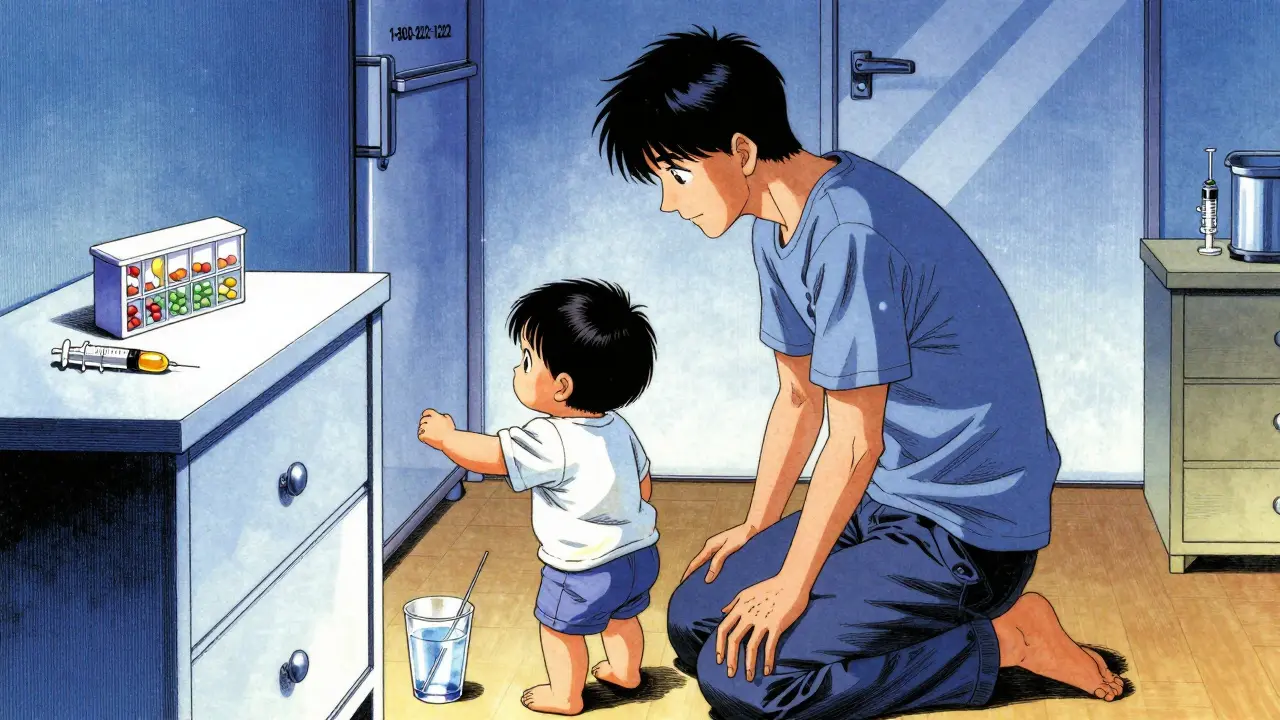
Children don’t just grow taller - they get smarter and more persistent. Around 9 to 12 months, they start pulling up. By 18 months, they’re climbing. By 2 years, they’re trying to open locks. Don’t wait until they’re already climbing on the toilet to secure your meds. Anticipate the next step. If your child is starting to stand, assume they’ll be climbing in 3 to 6 months. Lock cabinets before they need it. It’s not paranoia. It’s prevention.
Post the Poison Help number - everywhere
When something goes wrong, seconds matter. The Rural Health Information Hub found that homes with the Poison Help number (1-800-222-1222) posted visibly had response times 47% faster. That’s the difference between a trip to the ER and a call that saves a life. Put it on the fridge. On the back of the bathroom door. On the inside of the medicine cabinet. On your phone’s lock screen. Save it as a contact named “Poison Help.” If your child swallows something, call immediately - don’t wait for symptoms. Poison Control’s 2023 data shows that calling within 5 minutes improves outcomes by 89%. You don’t need to be sure it’s poison. Call anyway. They’re trained to help.
Learn basic life-saving skills
While you wait for help, you might need to act. Twelve percent of severe poisoning cases require immediate intervention - like the Heimlich maneuver or CPR - before paramedics arrive. Take a class. Many hospitals and community centers offer free pediatric first aid courses. You don’t need to be a doctor. You just need to know how to keep your child breathing until help comes. Keep your CPR certification current. It’s one of the most important skills you’ll ever learn.
What about smart medicine containers?
Technology is starting to help. Pilot programs with smart pill bottles that track when they’re opened and send alerts to your phone have shown a 63% drop in unsupervised access. These aren’t widely available yet - but they’re coming. In the meantime, the best tech is still a simple lock, a labeled bottle, and a habit of putting things away immediately after use.
It’s not about being perfect - it’s about being consistent
You don’t have to be flawless. You just have to be consistent. One time you leave the medicine on the counter. One time you forget to lock the cabinet. One time you say, “It’s just this once.” That’s when accidents happen. Prevention isn’t a one-time task. It’s a daily habit. Lock it. Put it away. Don’t call it candy. Measure with the tool. Post the number. Repeat. Every day. Because the safest home isn’t the one with no medicine - it’s the one where medicine is never within reach.
What should I do if my child swallows medicine accidentally?
Call Poison Control immediately at 1-800-222-1222. Don’t wait for symptoms. Don’t try to make your child vomit. Have the medicine bottle ready - they’ll ask what was taken, how much, and when. If your child is unconscious, not breathing, or having seizures, call 999 right away. Poison Control can guide you through next steps - and in many cases, they’ll tell you you don’t need to go to the hospital.
Are child-resistant caps enough to keep kids safe?
No. Child-resistant caps are designed to slow down a child, not stop them. Many toddlers can open them after a few tries, especially if they’ve seen you do it. Always store medicine in a locked cabinet - even if the bottle has a safety cap. The cap is a backup, not the main barrier.
Can I store medicine in the fridge?
Only if the label says to. Most medicines don’t need refrigeration. If they do, store them in a locked container inside the fridge - not on the top shelf. Toddlers can open fridge doors and pull down items. Never assume the fridge is safe just because it’s cold. Lock it.
What are the most dangerous medicines for toddlers?
Acetaminophen (Tylenol), ibuprofen (Advil, Motrin), and aspirin are the most common. But liquid nicotine from e-cigarettes is the most deadly - as little as half a milliliter can be fatal. Opioid patches, even used ones, are also extremely dangerous. All of these need to be locked up, regardless of how “safe” they seem.
Is it safe to keep medicine in a pill organizer?
No. Never store medicine in a pill organizer if your child can reach it. These containers have no labels, no warnings, and look like toys. Nationwide Children’s Hospital found that 25% of poisonings happen when medicine is moved from its original bottle. Keep everything in the original container - even if it’s inconvenient.
How can I make sure visitors don’t leave medicine within reach?
Have a small, locked box near the front door labeled “Visitor Medications.” Ask guests to put any pills, patches, or liquids inside. Make it normal. Say, “We keep everything locked for the kids - mind if we put yours here?” Most people understand. And if they don’t, you’re still protecting your child.
When should I start securing medicine in my home?
Start before your child can pull up. Around 6 to 9 months, babies start reaching for things. By 12 months, they’re pulling themselves up. Don’t wait until they’re climbing. Lock cabinets, hide purses, and remove meds from countertops before they’re able to reach them. Prevention is about anticipating, not reacting.

Write a comment
Your email address will not be published.
Recent Posts
-
 Viagra Jelly vs Top ED Alternatives - Detailed Comparison October 1, 2025
 -
 Anhydrous Crystalline Maltose: Boost Energy & Stamina in Your Diet September 22, 2025


10 Comments
I never realized how many everyday things could be deadly until I read this. My toddler just started pulling up, and I immediately checked every cabinet. Turns out I had ibuprofen sitting on the bathroom counter. Now it’s locked away. Scary how easy it is to get complacent.
So let me get this straight-we’re supposed to treat medicine like it’s a loaded gun, but it’s fine to leave your phone within reach so your kid can swipe through TikTok for hours? 🤦♀️
This is the kind of post that makes you pause and actually look around your house. I used to think ‘child-resistant’ meant safe. Nope. My 14-month-old opened my vitamin bottle last week-thank god it was just a multivitamin. Now everything’s in a magnetic lock cabinet. Worth the $20 investment.
Americans always overreact. In Nigeria, we let kids take medicine like candy and they grow strong. You lock everything? That’s weak parenting. My cousin’s kid swallowed 5 pills once and laughed it off. You think your kid is fragile? They’re not. Stop coddling them with locks and fear.
I’m the quiet guy who reads everything twice. I never thought about the purse thing. My sister-in-law left her pain patches on the couch last Christmas. My niece grabbed one. We didn’t realize until she started drooling. That’s when I installed the front-door lockbox. Best $15 I ever spent.
Lock it. Put it away. Don’t call it candy. Measure with the tool. Post the number. Repeat. Every day. This is not hard. It’s not complicated. It’s just something you do. Like buckling your seatbelt. You don’t think about it. You just do it. Because your kid’s life depends on it.
I just checked my kitchen cabinet… and I have a bottle of melatonin sitting right next to the gummy vitamins. Oh my god. I’m literally a walking hazard. Gonna move it tonight. And I’m buying a lockbox for visitors. I’m so embarrassed… but also so grateful for this post!
The empirical data presented herein is statistically significant and aligns with CDC pediatric poisoning surveillance metrics. However, the conflation of anecdotal parental behavior with systemic safety infrastructure is methodologically unsound. The assertion that ‘child-resistant caps are inadequate’ is corroborated, yet the proposed solution-magnetic locks-lacks scalability in low-income households. A policy-level intervention is warranted.
I used to think I was being careful-until my daughter opened my wife’s pill organizer and ate five of them. We got lucky. No hospital. Just a frantic 20 minutes and a call to Poison Control. Since then? Every. Single. Medicine. Locked. Even the ones I take twice a year. I don’t care if it’s inconvenient. I care that she’s alive. This isn’t about being perfect. It’s about being consistent. And if you’re not doing this? Please, just start today. Your kid doesn’t need a perfect parent. They need a safe one.
The structural vulnerability in domestic medication storage is a direct consequence of neoliberal parenting paradigms that prioritize convenience over safety. The recommended magnetic locks are a Band-Aid solution. What’s needed is a mandatory federal standard for child-proofing pharmaceutical packaging, enforced through the FDA and integrated with smart IoT monitoring systems. The current approach is reactive, not preventive. Also, your ‘child’s eye view’ heuristic is anthropologically sound but lacks quantitative validation.