

Managing a handful of pills every morning is tough. Now imagine juggling ten different prescriptions, each with its own schedule and side effects. For many seniors living at home, this is daily reality. The stakes are high: medication errors account for approximately 30% of all adverse events in home healthcare settings. One missed dose or one accidental double-dose can lead to an emergency room visit. This is where professional Home Health Services specializing in structured systems designed to ensure patients safely and effectively administer prescribed medications within residential environments step in. They don't just hand you a pillbox; they build a safety net around your health routine.
If you are looking to use these services, you need to know exactly what they cover, who qualifies, and how to make the most of them. This guide breaks down the process so you can avoid common pitfalls and keep your loved ones safe.
What Exactly Is Home Health Medication Management?
Many people confuse home health aides with skilled nurses. Understanding the difference is crucial when it comes to medicine. Home health medication management is not about someone standing over your shoulder watching you swallow a tablet. It is a comprehensive system.
According to industry standards, effective management includes maintaining updated medication lists that contain brand names, generic names, dosages, schedules, prescribing providers, and known side effects. It involves tracking intake accurately and scheduling medication times to fit into daily life. The goal, as defined by leading agencies like CritiCare Plus, is to improve patient health outcomes and adherence while preventing complications from improper use.
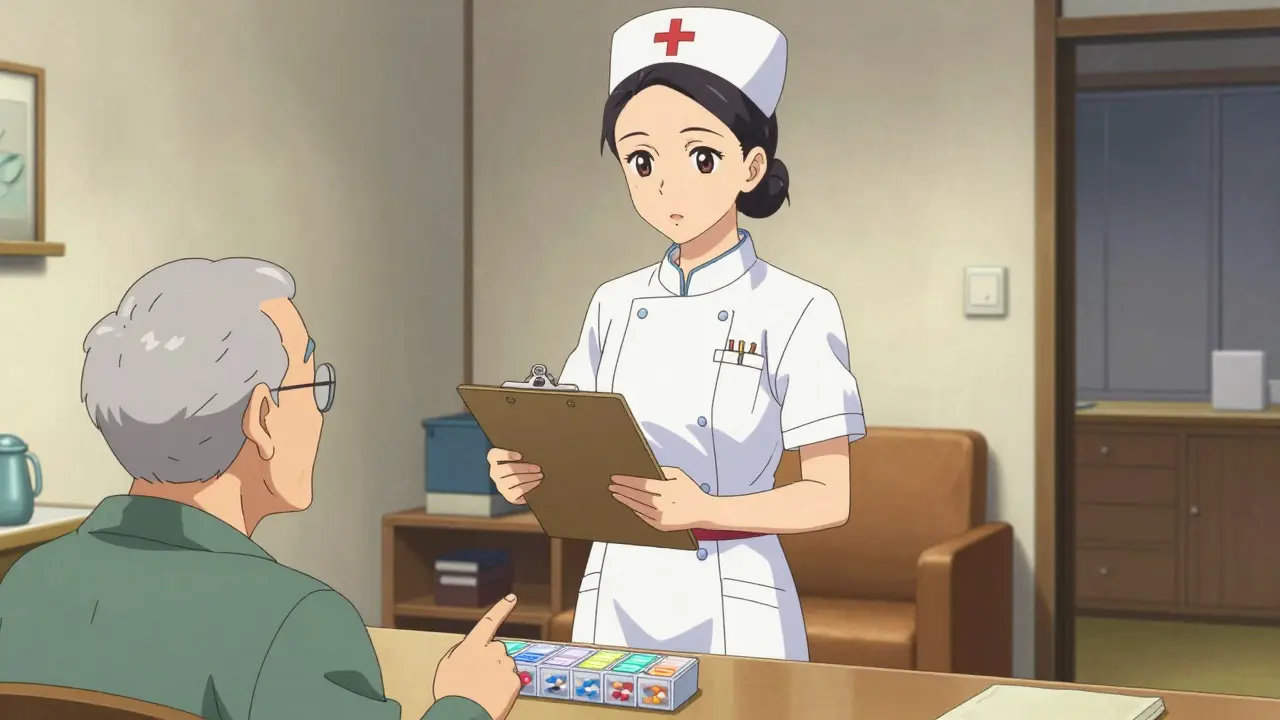
This service often falls under the umbrella of Skilled Nursing Care provided in the home setting. A registered nurse (RN) or licensed practical nurse (LPN) typically handles the complex parts, such as assessing interactions between drugs, while a certified nursing assistant (CNA) might help with reminders and organization.
Who Qualifies for These Services?
You cannot simply call a home health agency and ask for daily medication help. There are strict eligibility rules, primarily driven by insurance coverage. In the United States, Medicare Part A covers intermittent skilled nursing visits for medication management. "Intermittent" is the key word here. You usually need to be homebound and require skilled care, such as wound care or physical therapy, alongside your medication needs.
If you only need help taking pills but are otherwise healthy and mobile, Medicare often denies coverage. In those cases, you might look at private duty home care agencies. However, these come out of pocket. Private agencies charge between $20 and $40 per hour for medication management services. Some long-term care insurance policies or Medicaid waivers may cover these costs, depending on your state and specific plan.
It is vital to check your specific benefits. Ask your doctor if you meet the "homebound" criteria. If you do, a physician must order the home health services. Without a doctor's order, the clock doesn't start ticking on your coverage.
The Core Components of Professional Management
When a home health team arrives, they don't just organize pills. They perform a critical process called Medication Reconciliation which involves comparing current medications against hospital records to prevent errors during care transitions. This is where most mistakes happen-when a patient leaves the hospital and goes home. Discrepancies must be resolved quickly to prevent adverse drug events.
Here is what a robust medication management plan looks like:
- Comprehensive Medication List: A single document shared with all healthcare providers. It lists every prescription, over-the-counter drug, and supplement. This avoids dangerous interactions.
- Organizational Tools: Agencies often provide or recommend tools like weekly pill organizers or blister packs. Data shows that using pill organizers reduces medication errors by up to 45% in home settings.
- Digital Reminders: Modern services integrate smartphone apps with alarms and reminders. These apps can improve adherence rates by 35%, according to recent analyses.
- Regular Reviews: Skilled nurses conduct regular reviews using guidelines like the Beers Criteria to identify potentially inappropriate medications for older adults. This helps catch drugs that might cause confusion or falls.
Step-by-Step: How to Set Up Your Plan
Getting started requires coordination. Here is a practical roadmap to ensure smooth implementation.
- Get a Doctor's Order: Schedule a visit with your primary care physician. Explain that managing medications at home has become difficult. Ask for a referral to a Medicare-certified home health agency if you qualify.
- Choose the Right Agency: Not all agencies are equal. Look for one that specializes in geriatric care. Check their compliance record. MedPro's analysis revealed that only 65% of home health agencies consistently perform thorough medication reconciliation. You want an agency that does it right every time.
- Initial Assessment: When the nurse arrives, expect a deep dive. They will review all prescriptions for duplicates, verify insurance coverage, cross-check side effects, and confirm your understanding through "teach-back" methods. This means they will ask you to explain back to them how and when to take each drug.
- Create Visual Aids: Request charts with simple, large text in your preferred language. Surveys show that 67% of caregivers find these visual aids significantly improve understanding. Place these charts near the medication storage area.
- Establish a Routine: Work with the nurse to align medication times with meal times or bedtime. Using natural daily cues improves adherence by 28%. If a medication conflicts with your routine, discuss alternatives with your doctor immediately.
Technology and Tools That Help
Technology is changing how we manage meds at home. It is no longer just about paper lists. Many agencies now use digital planners with biometric verification for dose confirmation. In pilot programs, this reduced administration errors by 40%.
Consider asking your provider about Blister Packaging Systems like WellPack, which utilize individual daily medication pouches to organize complex regimens. These pre-packaged doses eliminate the guesswork. You open the packet labeled "Tuesday Morning" and take what is inside. No counting, no measuring.
For families caring for distant relatives, some apps allow remote monitoring. You can see if a dose was confirmed via biometric scan or manual entry. This provides peace of mind without hovering.
| Feature | Self-Management | Professional Home Health Service |
|---|---|---|
| Error Rate Reduction | Baseline (High Risk) | Up to 60% reduction in adverse events |
| Cost | $0 direct cost (but high hidden ER costs) | Covered by Medicare (if eligible) or $20-$40/hr privately |
| Complexity Handling | Poor for 5+ medications | Excellent for polypharmacy and complex regimens |
| Reconciliation | Rarely done thoroughly | Mandatory at every care transition |
| Hospital Readmission Risk | Higher | 20% lower 30-day readmission rate |
Common Pitfalls to Avoid
Even with professional help, things can go wrong if you aren't vigilant. Here are the biggest traps families fall into.
Inconsistent Communication: One Reddit user shared a story where inconsistent communication between providers led to a dangerous interaction between blood thinners, requiring ER treatment. Always ensure the home health nurse talks directly to the specialist doctors. Don't rely on passing notes through family members.
Ignoring Over-the-Counter Drugs: Patients often forget to list vitamins, herbal supplements, or painkillers bought at the pharmacy. These can interact with prescription drugs. Treat every substance entering your body as part of the medication regimen.
Scheduling Conflicts: Thirty-one percent of caregivers struggle with medications that need to be given at specific times conflicting with daily routines. If a drug must be taken at 3 AM and it disrupts sleep, talk to the doctor. Sometimes timing can be adjusted, or the formulation changed.
Assuming Coverage is Permanent: Medicare coverage for home health is not indefinite. It ends when you no longer need skilled care. If your wound heals but you still need med help, you might lose coverage. Plan for this transition early by exploring private options or community resources.
Costs and Financial Considerations
Money is a major factor. If you qualify for Medicare, the service is free at the point of care. However, you are responsible for 20% of the Medicare-approved amount for durable medical equipment, which might include specialized pill dispensers.
If you pay privately, calculate the total monthly cost. At $30 an hour for two hours a day, five days a week, that is roughly $3,000 a month. Compare this to the cost of a hospital stay. Clarest's Economic Impact Study found that medication management services prevent approximately $1,200 in avoidable hospital costs per patient monthly. The investment often pays for itself by keeping you out of the hospital.
Check with local Area Agencies on Aging. They may offer subsidies or volunteer programs for non-skilled medication reminders, which can bridge the gap when skilled nursing isn't covered.
FAQ
Does Medicare cover daily medication assistance?
Generally, no. Medicare Part A covers intermittent skilled nursing visits for medication management if you are homebound and have a doctor's order. It does not typically cover daily, non-skilled assistance for taking pills unless it is tied to other skilled therapies like physical rehabilitation. For daily help, you may need private pay or long-term care insurance.
What is the difference between a home health aide and a nurse regarding medications?
A Registered Nurse (RN) or Licensed Practical Nurse (LPN) can assess medication needs, adjust plans (in consultation with doctors), and handle complex injections or IVs. A Home Health Aide (HHA) or Certified Nursing Assistant (CNA) typically provides reminders and assists with organizing pills but cannot assess drug interactions or change dosages. Laws vary by state, so always check local regulations.
How do I choose a reliable home health agency?
Look for agencies certified by Medicare and accredited by organizations like The Joint Commission. Ask specifically about their medication reconciliation protocols. Check online reviews and ask for references. Ensure they have low staff turnover, as consistency is key for building trust and catching subtle changes in health status.
Can home health services reduce hospital readmissions?
Yes. Studies show that patients receiving professional medication management support experience a 20% reduction in 30-day hospital readmissions compared to those managing independently. Proper reconciliation and monitoring prevent the adverse drug events that often trigger emergency visits.
What should I do if my loved one refuses to take their medication?
This is common, especially with dementia. Involve the home health nurse immediately. They can assess if the refusal is due to side effects, difficulty swallowing, or cognitive decline. Strategies might include switching to liquid forms, combining doses, or using discreet delivery methods. Never force medication, as this can cause aspiration or trauma.

Recent Posts
-
 DASH Diet Guide: Lowering Blood Pressure and Managing Weight August 20, 2026