
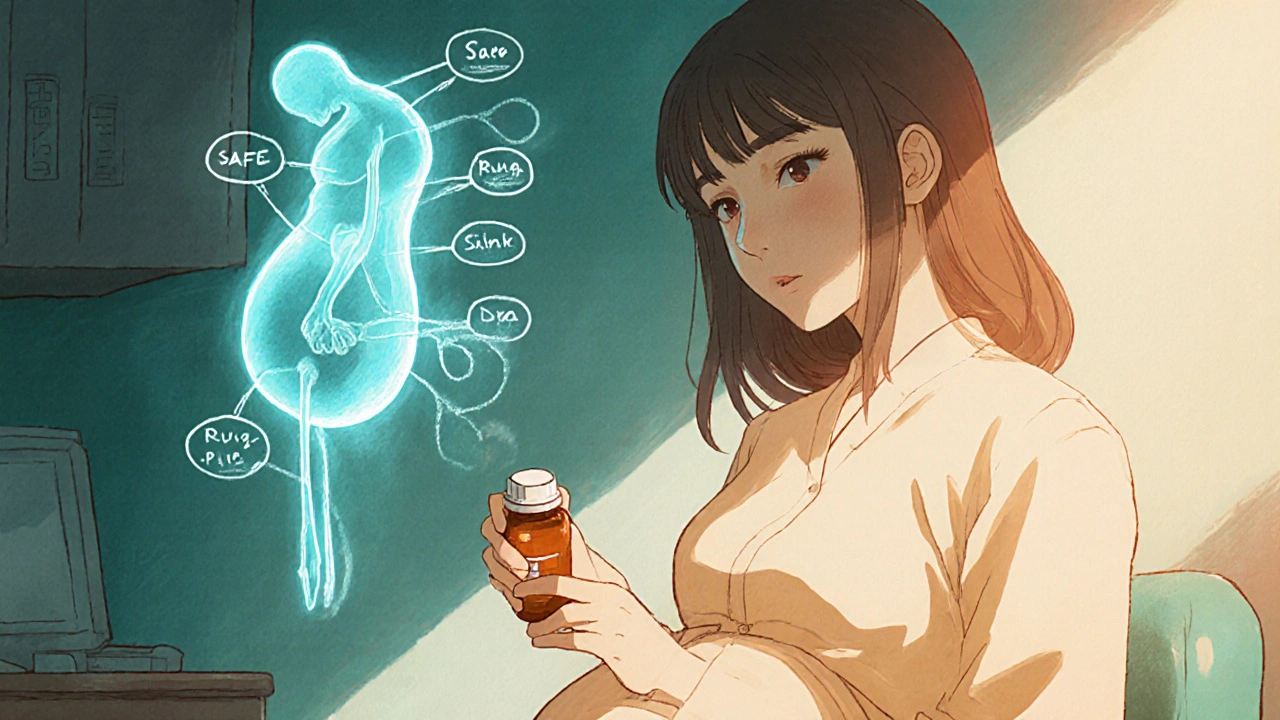
Pregnancy Medication Safety Checker
Check Medication Safety
Enter the medication name to see evidence-based safety information for pregnancy. Note: This tool does not replace professional medical advice.
When you’re pregnant, every pill, supplement, or over-the-counter remedy feels like a gamble. You want to feel better, but you’re terrified of hurting your baby. The truth isn’t black and white - but it’s not as scary as the internet makes it seem. About 2-3% of birth defects are linked to medications taken during pregnancy. That means for every 100 babies born with a defect, only 2 or 3 have a connection to a drug. The rest come from genetics, environment, or unknown causes.
What Exactly Is a Teratogen?
A teratogen is any substance that can interfere with fetal development and cause birth defects. It’s not just about illegal drugs or dangerous chemicals. Even common prescriptions and OTC meds can be teratogenic if taken at the wrong time or in the wrong dose. The most famous example? Thalidomide. In the late 1950s, this sleeping pill caused severe limb deformities in about 10,000 babies worldwide before being pulled from shelves. That tragedy changed how we test drugs for pregnancy safety - forever.When You’re Most at Risk
The first trimester - weeks 1 to 12 - is the most dangerous window. That’s when your baby’s organs are forming. Between days 15 and 60 after conception, even a small exposure can cause major problems like heart defects, cleft palate, or missing limbs. After week 12, the risk of structural damage drops, but it doesn’t disappear. In the second trimester, medications might affect brain development or cause hearing loss. In the third trimester, the biggest risks are withdrawal symptoms, low birth weight, or problems with how organs function after birth.Medications With Proven Risks
Some drugs are known dangers. If you’re taking one of these, don’t panic - but do talk to your doctor right away.- Warfarin: Can cause fetal warfarin syndrome - a mix of facial deformities, bone problems, and intellectual disability. Risk is highest in the first trimester.
- Methotrexate: Used for cancer and autoimmune diseases, it blocks folate, which your baby needs to build a healthy spine. Increases neural tube defect risk by 10-20%.
- Carbamazepine: An epilepsy drug linked to a 1% chance of spina bifida and bleeding issues in newborns due to low vitamin K.
- Factor Xa inhibitors (rivaroxaban, apixaban): These blood thinners cross the placenta. There’s no antidote if bleeding happens. Avoid them entirely.
- Cannabis (THC): Increases risk of preterm birth, low birth weight, and stillbirth. THC stays in breastmilk for up to six days and may affect your baby’s attention and learning later on.
The Acetaminophen Debate
This is where things get messy. Acetaminophen (also called paracetamol) is the go-to painkiller for pregnant women. It’s in Tylenol, Excedrin, and hundreds of cold medicines. For years, doctors said it was safe. Now, some studies suggest a possible link to autism and ADHD - especially with long-term, daily use. Here’s the catch: no one has proven it causes these conditions. The CDC says “some studies show an association,” but stops short of saying it’s a cause. Meanwhile, the American College of Obstetricians and Gynecologists (ACOG) came out strongly in September 2025, saying: “The risks of untreated fever or pain are far greater than any theoretical risk from acetaminophen.” Think about it: If you have a high fever during pregnancy, your baby’s risk of neural tube defects goes up by 20-30%. If you’re in constant pain, your stress hormones can affect fetal growth. So while we keep studying acetaminophen, most experts still say: use it when needed, at the lowest dose, for the shortest time. Don’t avoid it out of fear - but don’t take it daily without a reason.
Why So Much Uncertainty?
You might wonder: Why don’t we know more? Why aren’t there clear answers? Because we can’t run clinical trials on pregnant women. It’s unethical. So almost all the data we have comes from watching what happens after the fact - looking at birth records, tracking moms who took meds, or studying animals. That’s why about 70-80% of medications lack solid pregnancy safety data. Even if a drug is labeled “safe,” it might just mean “we don’t have proof it’s harmful.” The FDA changed the system in 2015 to fix this. Instead of silly letter categories (A, B, C, D, X), labels now give real narratives: “There are 12 case reports of heart defects...” or “Animal studies showed no risk, but human data is limited.” It’s better - but still confusing. Many doctors still use the old letters because they’re easier to remember.What Should You Do?
You don’t need to become a pharmacologist. But you do need a plan.- Before you get pregnant: Review every medication you take - prescriptions, supplements, even herbal teas. Talk to your OB or a pharmacist. Some meds can be swapped for safer ones before conception.
- If you’re already pregnant: Don’t stop anything cold turkey. Stopping seizure meds, antidepressants, or blood pressure drugs can be more dangerous than keeping them. Work with your team to adjust doses or switch if needed.
- When in doubt: Call MotherToBaby. They’re a free service run by teratology experts. They answer over 10,000 calls a year. Most questions are about acetaminophen, antidepressants, or nausea meds like Zofran.
- Don’t trust Google: One Reddit thread says Zofran causes birth defects. Another says it’s safe. The truth? The data is mixed. Only your doctor can weigh your personal risk.
Who’s Responsible?
It’s not just your job to be careful. Your healthcare team needs to be proactive. Nurses should ask about meds at every visit. Pharmacists should review your list. Your OB should know what you’re taking - even if you think it’s “just a vitamin.” The best outcomes happen when there’s a team: doctor, pharmacist, nurse, and you. If you’re on antidepressants, your psychiatrist should talk to your OB. If you’re on insulin, your endocrinologist should know you’re pregnant. Communication saves lives.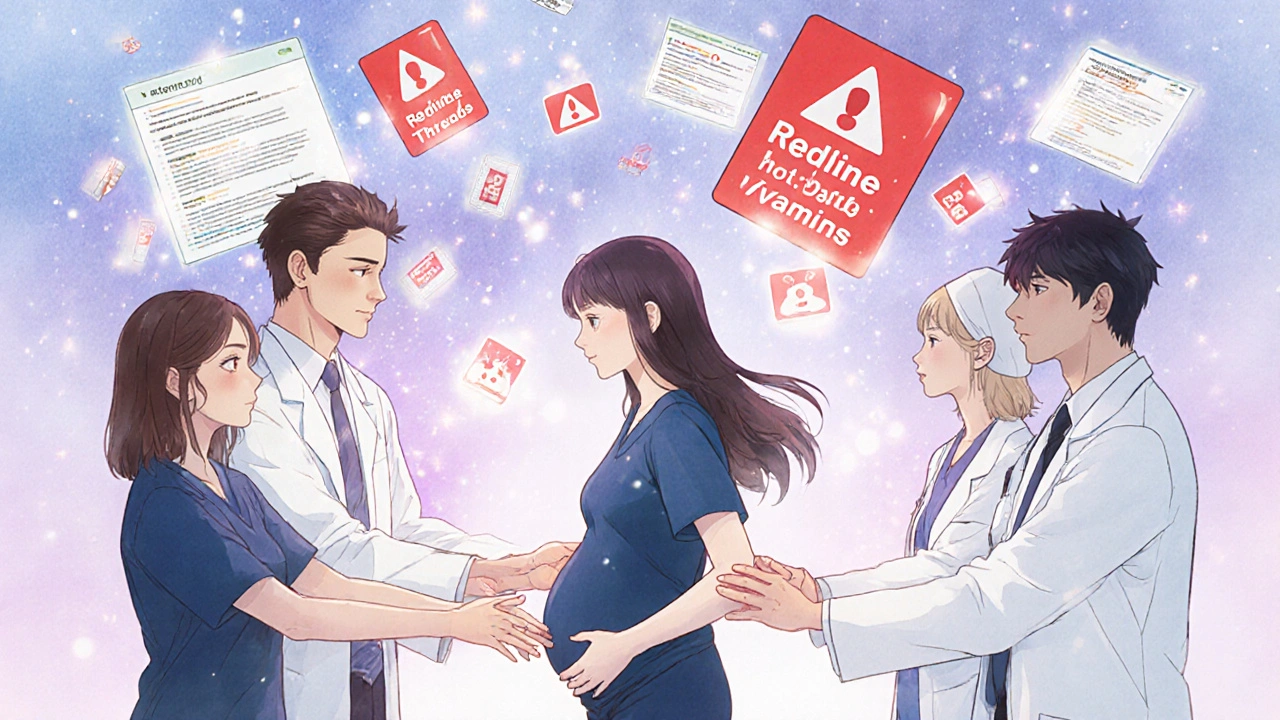
What’s Changing Now?
The FDA is working on something called the Sentinel Initiative - tracking 10 million patient records to spot patterns in pregnancy medication use. By 2026, we’ll have way better real-world data. Researchers are also exploring pharmacogenomics - testing your genes to see how you metabolize drugs. That could mean personalized advice: “Your body breaks down this med slowly, so avoid it,” or “You’re fine with this dose.” But here’s the hard part: Only 2-3% of maternal health research funding goes to medication safety. That’s out of sync with how many women take meds during pregnancy. About 90% of pregnant women take at least one drug. We need more science - not more fear.Bottom Line
You’re not alone in worrying. Most women feel this way. But fear shouldn’t stop you from treating pain, fever, depression, or high blood pressure. The goal isn’t to avoid all meds - it’s to use the right ones, at the right time, in the right dose. If you’re planning pregnancy, get your meds reviewed. If you’re already pregnant and took something before you knew, call your doctor. Most exposures don’t cause harm. And if you’re unsure? Talk to someone who knows - not a forum, not a blog, not a stranger on Instagram. Your health and your baby’s health depend on accurate, personalized advice - not guesswork.Can I take ibuprofen while pregnant?
Avoid ibuprofen after week 20 of pregnancy. It can cause low amniotic fluid and heart problems in the baby. Before week 20, occasional use is usually okay, but acetaminophen is still the safer choice. Always check with your doctor first.
Is it safe to take prenatal vitamins with extra iron?
Yes. Prenatal vitamins with iron are safe and recommended for most pregnant women. Iron helps prevent anemia, which can lead to preterm birth and low birth weight. The amount in standard prenatal vitamins is not teratogenic. If you have hemochromatosis or other iron disorders, talk to your doctor - but for most, it’s essential.
What if I took a medication before I knew I was pregnant?
Don’t panic. Most exposures don’t cause harm. The critical window for major defects is between days 15 and 60. If you took something before that, your baby may have already passed the risk stage. Call MotherToBaby or your OB. They’ll help you assess the specific drug, timing, and dose. In many cases, the risk is very low - or even negligible.
Are herbal supplements safe during pregnancy?
Many are not. Herbs like black cohosh, pennyroyal, and dong quai can cause contractions or bleeding. Even “natural” doesn’t mean safe. There’s little research on most herbal products in pregnancy. Stick to prenatal vitamins and avoid supplements unless your doctor approves them.
Can antidepressants cause birth defects?
Some SSRIs, like paroxetine, have a slightly higher risk of heart defects when taken in the first trimester. But untreated depression carries risks too - including poor prenatal care, substance use, and preterm birth. If you’re on antidepressants, don’t stop without talking to your doctor. Switching to a safer option like sertraline may be possible, but only under medical supervision.
Does every medication have a pregnancy warning?
No. Many drugs, especially older ones, have no clear data. The FDA’s labeling system now requires more detail, but if a drug was approved before 2015, its label might still say “Category C” - which means “risk can’t be ruled out.” That’s not the same as “dangerous.” Always ask your doctor or pharmacist for the latest evidence, not just the label.
Next Steps
If you’re trying to get pregnant: Schedule a preconception visit. Bring your pill bottle list. Ask: “Which of these do I need to stop or switch?” If you’re already pregnant: Don’t skip your next appointment. Tell your provider every medication you’ve taken - even if you think it’s harmless. If you’re unsure about a drug, call MotherToBaby at 1-866-626-6847. They’re free, confidential, and staffed by specialists. The goal isn’t perfection. It’s awareness. You’re not a risk - you’re a person making informed choices. And that’s what matters most.
Write a comment
Your email address will not be published.
Recent Posts
-
 Authorized vs Traditional Generics: Key Differences Explained August 26, 2026
 -
 Zovirax Prescription Online: What You Need to Know March 18, 2025
 -
 Bioequivalence Testing for Generic Drugs: What It Proves March 5, 2026

15 Comments
I’ve been thinking a lot about this since my wife got pregnant last year. We had this whole panic about every vitamin and cold medicine she took before she knew she was pregnant. Turns out, most of it was fine. The real issue isn’t the meds-it’s the fear-mongering online. I spent hours reading Reddit threads that sounded like horror stories, but the science? It’s way more nuanced. The 2-3% stat really puts it in perspective. We called MotherToBaby and they walked us through every pill she’d taken. No drama. No panic. Just facts. That’s what pregnant people need-not algorithms pushing worst-case scenarios.
Acetaminophen is a gateway drug for lazy moms who think ‘it’s just a little pain.’ If you can’t handle a headache without chemicals, maybe you shouldn’t be pregnant.
I get why the article says not to panic, but honestly? I’m still panicking. I took ibuprofen for a migraine at 8 weeks. I’ve been Googling ‘birth defects ibuprofen’ every night since. I know it’s probably fine, but I can’t stop. Why does it have to be this hard?
Let’s cut the BS. The FDA’s new labeling system is just corporate-speak dressed up as transparency. ‘Risk can’t be ruled out’? That’s code for ‘we didn’t test it and we don’t care.’ And don’t get me started on ‘Category C’-it’s not a category, it’s a cop-out. Real science would involve actual human trials, not post-hoc birth registry scavenger hunts. We’re treating pregnancy like a liability, not a biological reality.
As a clinical pharmacist with over 15 years of experience in maternal-fetal pharmacotherapy, I must emphasize that the data on acetaminophen remains observational and confounded by indication. The association with neurodevelopmental outcomes is not causal. Furthermore, the American College of Obstetricians and Gynecologists’ position is evidence-based and clinically prudent. Uncontrolled maternal fever poses a significantly higher teratogenic risk than therapeutic acetaminophen use. Patients should be counseled on risk-benefit ratios, not fear.
Western medicine is overreliant on pharmaceuticals. In Nigeria, we use ginger, lemon, and rest. No pills. No panic. You’re medicating symptoms, not healing. This whole system is broken.
Given the ethical constraints on clinical trials involving pregnant women, how do researchers mitigate selection bias in retrospective cohort studies? Are there any recent meta-analyses that control for confounding variables such as socioeconomic status, maternal BMI, and concurrent substance use?
I appreciate how balanced this post is. I used to think all meds were dangerous during pregnancy, but now I see it’s about timing, dose, and medical guidance. My sister took SSRIs through her whole pregnancy and her daughter is now a healthy toddler. The key is talking to your doctor, not scrolling Reddit at 3 a.m.
Let me tell you something real-pregnancy is not a disease. It’s a natural process that our bodies were designed for. But somewhere along the way, we turned it into a minefield of warnings. I’m from Nigeria, and in my village, women take herbs, eat local foods, and trust their bodies. We don’t have pharmacists at every corner, but we have generations of wisdom. That doesn’t mean we ignore science-but we don’t let fear dictate our choices. The real danger isn’t acetaminophen. It’s losing trust in ourselves because someone told us every pill is a threat.
Oh wow, so now I’m supposed to feel guilty for taking Tylenol because I had a migraine and didn’t want to scream into a pillow for three hours? Thanks, science. Really. I’m just here trying to survive my third trimester without crying in the shower. You’re telling me I should suffer so a study can someday say ‘maybe it’s linked’? I’ll take my 500mg and my peace of mind, thanks.
omg i just realized i took zofran for 5 weeks before i knew i was preg 🤯 but then i read the study and it said the risk is like 0.1% and my doctor said its fine so i’m just gonna keep breathing 😭🙏
My wife took warfarin for a blood clot before she knew she was pregnant. We were terrified. But we talked to her OB and a specialist. They switched her to heparin right away. No defects. Baby’s now 2 and running around like a maniac. The system works if you use it. Don’t hide. Don’t panic. Just ask.
But what about the long-term effects on the child’s brain? I mean, we don’t know what happens when they’re 10, right? What if it’s ADHD or anxiety? Isn’t that worse than a fever?
so like… i took like 3 advils and a glass of wine and now my baby is gonna be like… a mutant? i’m literally crying rn 😭😭😭 i need someone to tell me it’s gonna be ok
i think this post is really good. i’m from india and we don’t talk about this stuff much. my mom says take whatever you need, but i was scared. now i feel better. thank you for writing this. also, mother to baby number is saved in my phone now 😊