
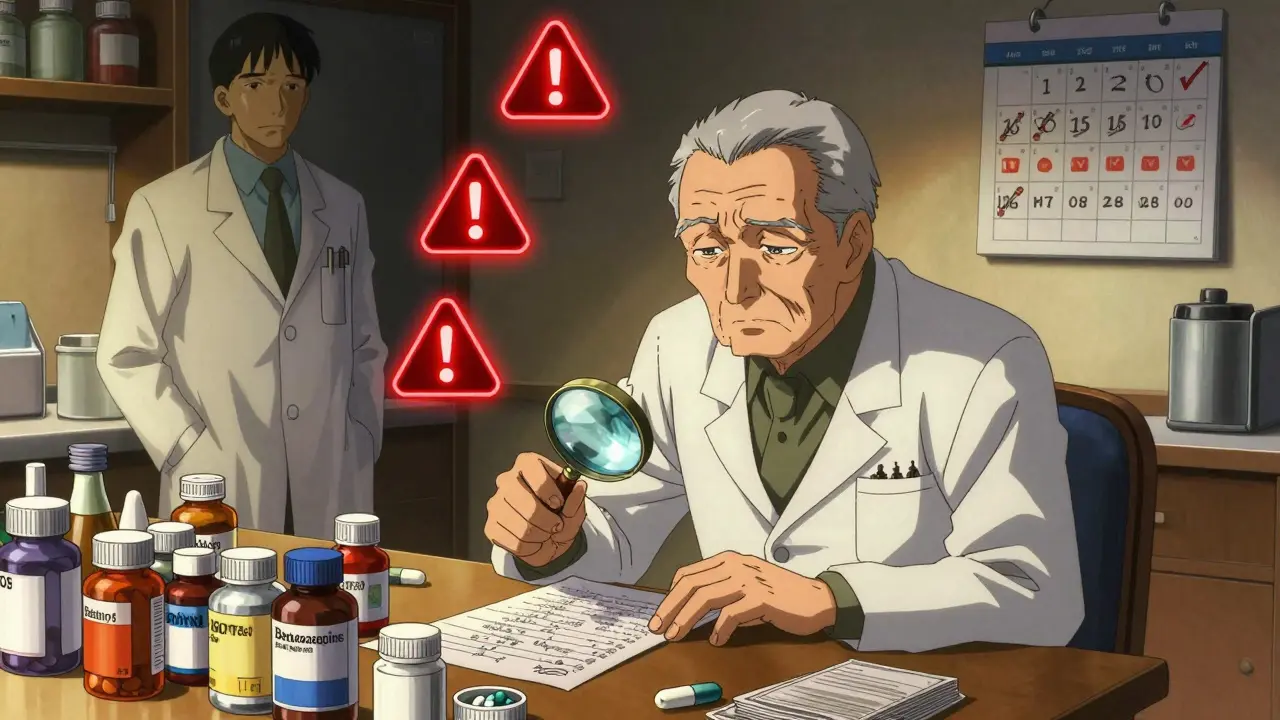
More than 40% of adults over 65 in the U.S. are taking five or more medications every day. For many, this isn’t a choice-it’s the result of seeing multiple doctors, filling prescriptions at different pharmacies, and not having a single person look at the full picture. This is polypharmacy, and while it’s common, it’s far from harmless.
What Polypharmacy Really Means
Polypharmacy isn’t just about having a lot of pills. It’s when the number of medications starts to do more harm than good. The medical community defines it as taking five or more prescription drugs regularly. But the real problem isn’t the count-it’s the hidden risks. Older adults metabolize drugs differently. Their liver and kidneys don’t work as efficiently. A dose that was safe at 50 can become dangerous at 75. What’s worse? Many of these drugs interact in ways no one ever checked. Consider this: one in three seniors takes a medication that the American Geriatrics Society says should be avoided in older adults. Benzodiazepines for sleep? They double the risk of falls. NSAIDs for arthritis? They can cause dangerous stomach bleeds. Anticholinergics for overactive bladder? They raise the chance of dementia over time. These aren’t rare mistakes. They’re routine.Why Seniors End Up on So Many Medications
It starts with good intentions. A heart doctor prescribes a beta-blocker. A rheumatologist adds an anti-inflammatory. A neurologist prescribes a sleep aid. Then, after a hospital stay, a new antibiotic gets added. No one sits down and asks: "What are we trying to fix here?" Care transitions are the biggest culprit. When a senior moves from hospital to home, or from a rehab center to a nursing home, medication lists get copied, not reviewed. Studies show that 50% of post-discharge complications come from medication errors during these handoffs. One man in his 80s was taking 17 pills a day. When his pharmacist finally sat down with him and his daughter, they found 10 of them were unnecessary-or worse, dangerous. Another problem? Multiple prescribers. Nearly half of older adults see three or more specialists. Each one focuses on their own area. No one sees the whole puzzle. And most patients don’t know what half the pills are for. Only 55% can correctly name the purpose of every medication they take.The Hidden Dangers: Falls, Confusion, and Hospital Trips
The consequences are real-and often avoidable. Falls are the leading cause of injury in seniors. And drugs like sedatives, antipsychotics, and even some blood pressure pills increase fall risk by up to 50%. One fall can mean a broken hip, surgery, long-term care, and a steep decline in quality of life. Then there’s delirium. A sudden confusion, disorientation, or agitation that can look like dementia but is often caused by a new medication or drug interaction. Up to 35% of emergency visits by seniors are linked to adverse drug reactions. And nearly 10% of all hospital admissions for people over 65 are preventable, according to the World Health Organization, mostly because of medication problems. Cost is another silent burden. One in four seniors skips doses because they can’t afford their meds. Some cut pills in half. Others wait until the next payday. These aren’t lazy choices-they’re survival tactics.
How to Start Fixing It: The Brown Bag Review
The simplest place to start is the "brown bag review." Ask the senior to bring every medication they take to their next doctor’s visit. Not just prescriptions-include vitamins, supplements, over-the-counter painkillers, and even eye drops. In a typical review, pharmacists and doctors find 2.8 unnecessary, duplicate, or harmful medications per person. One woman was taking two different blood pressure pills that did the same thing. Another was on a stomach acid reducer for five years-long after his ulcer had healed. Both were stopped with no downside. This isn’t about taking away meds. It’s about asking: "Is this still helping?"Deprescribing: The Smart Way to Reduce Risk
Deprescribing isn’t just stopping pills. It’s a planned, step-by-step process of removing medications that no longer serve the patient’s goals. It’s not about age-it’s about priorities. For example: A 78-year-old with advanced dementia isn’t benefiting from a cholesterol pill meant to prevent a heart attack in 10 years. She’s more likely to suffer side effects-muscle pain, confusion, fatigue. Removing it improves her comfort and energy. The American Geriatrics Society recommends focusing first on high-risk drugs:- Benzodiazepines (like Valium, Xanax)
- Anticholinergics (like diphenhydramine in Benadryl, oxybutynin)
- NSAIDs (like ibuprofen, naproxen)
- Opioids for chronic pain
- Proton pump inhibitors (like omeprazole) used long-term
Who Should Be Involved?
Managing polypharmacy isn’t a solo job. It needs a team:- Primary care doctor: Leads the review and coordinates care.
- Pharmacist: Checks for interactions, duplicates, and dosing issues. Medication therapy management by pharmacists reduces hospital readmissions by 24% in Medicare patients.
- Nurse or care coordinator: Helps the patient understand their regimen and tracks adherence.
- Family or caregiver: Often notices changes in behavior, confusion, or missed doses.
Tools and Systems That Help
Some health systems now use digital tools to catch problems before they happen:- STOPP/START criteria: A checklist that tells doctors which drugs to avoid and which ones to start based on age and condition.
- MedWise platform: An FDA-approved tool that uses a patient’s genetic info and current meds to predict dangerous interactions. In a 2022 trial, it cut adverse events by 41%.
- Medication Appropriateness Index (MAI): A scoring system that rates each drug for appropriateness, dosage, duration, and risk.
What Patients Can Do Today
You don’t need to wait for a perfect system. Here’s what you can do right now:- Keep a written list of every medication, supplement, and OTC drug you take-including dose and reason.
- Bring it to every appointment, even if you think it’s "just a vitamin."
- Ask your doctor: "Is this still necessary?" and "What happens if I stop it?"
- Speak up about cost. If a pill is too expensive, say so. There are often cheaper alternatives.
- Ask for a pharmacist consult. Many clinics now offer free medication reviews.
The Future: Personalized Medication Plans
The field is shifting. Instead of counting pills, experts now ask: "What’s the goal?" Is it to live longer? To stay independent? To avoid hospital trips? To feel better every day? New research funded by the National Institute on Aging is exploring how genetics, organ function, and lifestyle-not just age-should guide prescribing. The idea? Tailor meds to the person, not the number. In the next five years, we’ll likely see more clinics offering "medication optimization" as a standard service. And CMS has already started funding deprescribing programs across 15 health systems, with $15 million in grants. The message is clear: more pills don’t mean better care. Sometimes, less is more.Is taking five or more medications always dangerous for seniors?
Not always. Some seniors need multiple medications to manage serious conditions like heart failure, diabetes, or kidney disease. The danger isn’t the number-it’s whether each drug is still necessary, safe, and aligned with the patient’s goals. A 70-year-old with four well-monitored, essential meds is doing better than an 80-year-old on ten pills, half of which are outdated or risky.
Can I stop a medication on my own if I think it’s not helping?
No. Never stop a prescription without talking to your doctor. Some drugs, like blood pressure or antidepressant medications, can cause serious withdrawal effects if stopped suddenly. But you can-and should-ask your doctor: "Should I still be taking this?" Many medications can be safely tapered over weeks or months under supervision.
Why do doctors keep prescribing medications that are risky for seniors?
Often, it’s because they’re focused on one condition and don’t see the full picture. A cardiologist treats heart disease. A neurologist treats tremors. No one steps back to ask: "What’s the overall risk?" Also, many older drugs were approved decades ago with little testing in people over 75. And once a prescription is written, it just keeps getting refilled-unless someone actively reviews it.
What’s the difference between polypharmacy and appropriate prescribing?
Polypharmacy is a term that describes taking many drugs, often without clear purpose. Appropriate prescribing means every medication has a clear goal, is safe for the person’s age and health, and is monitored regularly. The goal isn’t to reduce the number of pills-it’s to make sure every pill is worth taking.
Are supplements and over-the-counter drugs really a problem?
Yes. Many seniors take herbal supplements like St. John’s Wort, ginkgo, or garlic pills thinking they’re harmless. But these can interact with blood thinners, blood pressure meds, and even chemotherapy. Over-the-counter painkillers like ibuprofen can cause kidney damage or stomach bleeding. And sleep aids like Benadryl are anticholinergics-linked to dementia. Always list everything you take, even "natural" products.
How often should a senior have a medication review?
At least once a year, but ideally after every hospital stay, ER visit, or change in health. If you’re seeing multiple specialists, a review every six months is ideal. Medicare now covers annual medication reviews for Part D beneficiaries, but only 15% of eligible patients actually get them. Don’t wait for them to call-ask for one.

Write a comment
Your email address will not be published.
Recent Posts
-
 Vitamin C for Age Spot Treatment: Step‑by‑Step Guide October 17, 2025
 -
 DASH Diet Guide: Lowering Blood Pressure and Managing Weight August 20, 2026
 -
 Betnovate (Betamethasone) vs Alternative Steroid Creams: Comparison Guide September 29, 2025


10 Comments
This is why America’s healthcare system is a dumpster fire.
Five or more meds? That’s not ‘care’-that’s pharmaceutical negligence with a side of profit.
I’ve seen grandmas on 14 pills, including three for ‘side effects’ of other pills. One was on a stool softener because the blood pressure med turned her gut to concrete. Then they prescribed another drug to fix the constipation. Then another for the nausea from the constipation drug.
It’s not medicine. It’s a Ponzi scheme wrapped in a white coat.
And don’t get me started on how pharmacies just refill everything automatically. No one’s checking. No one’s caring. Just billing codes and quarterly earnings.
Someone needs to sue the entire Medicare Part D system.
Also-why is Benadryl still OTC? It’s a dementia accelerator. They should ban it like they ban lead paint.
I get what you’re saying, but not all polypharmacy is bad. My mom’s on seven meds, and she’s been hiking every weekend for two years. She’s 81. Her cardiologist, endocrinologist, and geriatrician all coordinate. They reviewed everything last month. She’s doing great.
It’s not the number-it’s the intention. Some of us have good doctors. Not everyone’s trapped in the system.
You think this is about bad prescribing? Nah.
This is a deep-state pharmaceutical operation.
Big Pharma pays doctors to prescribe. The FDA approves drugs based on lobbying, not data.
They want seniors on 10 pills because that’s how they lock in lifetime revenue.
And the ‘brown bag review’? That’s a PR stunt. The real solution? Burn the entire prescription model.
Why do you think every drug ad on TV targets people over 65? Because we’re the cash cows.
They’re not trying to help us. They’re trying to keep us alive just long enough to keep paying.
And don’t tell me about ‘de-prescribing.’ That’s just a way to make you feel better while they keep selling you new ones next year.
Let’s be real: the term ‘polypharmacy’ is just a euphemism for ‘we didn’t bother to think.’
Doctors don’t have time. Pharmacists are overworked. Patients are confused. So we slap on another script like it’s a Band-Aid on a hemorrhage.
And the ‘STOPP/START’ criteria? Cute. But 90% of primary care docs don’t even know what it stands for.
Meanwhile, the AI tools like MedWise? They’re built on data from clinical trials that excluded people over 80. So the algorithm thinks a 75-year-old with three comorbidities is ‘low risk.’
It’s not incompetence. It’s systemic malpractice dressed in EHR templates.
I read this whole thing. Zero new info.
Everyone knows this.
Why are we still talking about it?
It’s like saying ‘water is wet.’
And the ‘brown bag’ thing? I’ve been doing that since 2018. No one ever changed anything.
So what’s the point? Just another feel-good article that makes people feel like they’re ‘doing something’ while the system keeps churning.
The human body is not a machine to be calibrated with chemical levers.
We have forgotten that medicine was once about balance, not dosage.
When we reduce a life to a list of drugs, we reduce the soul to a billing code.
The elderly are not problems to be optimized. They are witnesses to time.
Perhaps the question is not how to manage their pills-but how to honor their silence.
When we stop asking what they need to survive-and start asking what they need to be human-we might find that the best medicine is still the one we refuse to prescribe: presence.
I’m a geriatric pharmacist and I can tell you-this is 100% accurate.
I do 3-4 brown bag reviews a day. Last week, I found a 79-year-old on 12 meds. Six were duplicates. Two were for conditions that had resolved 8 years ago. One was a muscle relaxant she’d been taking since 2007 after a sprain.
We tapered her down to 4. She stopped falling. Her daughter cried. Said she hadn’t seen her mom this alert in a decade.
Deprescribing isn’t risky-it’s restorative.
And yes, the system is broken. But change happens one patient at a time.
If you’re reading this and you’re a caregiver-take the bag. Ask the questions. Demand the review. You’re not being ‘difficult.’ You’re being the advocate they forgot to hire.
The article mentions ‘adverse drug events’ dropping 22% with deprescribing.
But it doesn’t mention the 17% spike in hospitalizations from abrupt discontinuation in poorly managed cases.
And who’s responsible when a patient dies after a poorly tapered beta-blocker?
The doctor? The pharmacist? The family who didn’t understand the risks?
This whole movement is dangerously oversimplified.
It’s not ‘less is more.’ It’s ‘less is more-IF you have the infrastructure, expertise, and time to do it right.’
Most clinics don’t.
So we’re just swapping one risk for another. And calling it progress.
i read this and i was like wow but then i forgot half of it lol
my grandpa takes like 8 pills and i dont even know what half of them are for
he says dont worry about it
so i just make sure he eats his bananas
Deprescribing? Sounds like a buzzword invented by people who don’t actually work in geriatrics.
Here’s what really happens: insurance companies pressure doctors to cut costs. So instead of ordering tests, they just stop meds.
Then when the patient crashes, it’s ‘unforeseen complications.’
Meanwhile, the same system that pushes polypharmacy now pushes deprescribing as a cost-saving measure.
It’s not patient care. It’s financial triage.
And they call it ‘optimization.’