
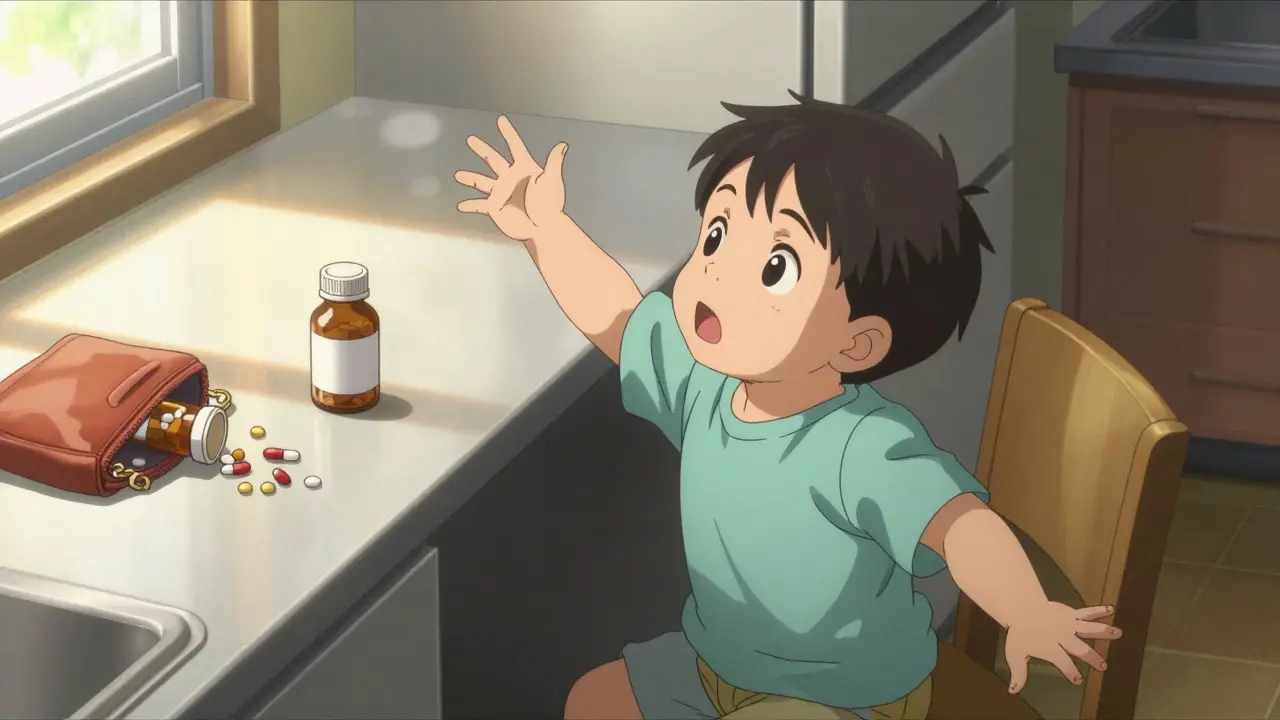
Every year in the UK, over 60,000 children under five end up in emergency rooms because they got into medications they weren’t supposed to. Most of these cases aren’t from strangers or bad luck-they happen because pills were left within reach. A child can climb a chair, open a drawer, or grab a purse left on the couch. And it doesn’t take long. In fact, nearly half of these accidents happen within five to ten minutes after someone takes their medicine and leaves the pills out.
Where Not to Store Medications
The bathroom is the most common mistake. It’s convenient-right next to the sink, easy to reach after brushing your teeth. But bathrooms are humid. Showers raise the moisture level to over 80%. That kind of dampness breaks down pills and liquids. Studies show 67% of common medications lose effectiveness within 30 days in a bathroom cabinet. Insulin, thyroid pills, and even aspirin can become useless or unsafe.
Countertops, nightstands, and coffee tables are just as risky. People think, “I’ll just leave it here so I don’t forget.” But toddlers can pull themselves up by age one. By two, they’re climbing. A study from Washington State found that 48-inch shelves-what most people think is “high enough”-are easily reached by children as young as 24 months.
And don’t rely on purses, coats, or bags. One in four poisoning cases in grandparents’ homes happens because someone left their medication in a handbag or jacket pocket. A child finds it, thinks it’s candy, and eats it. Grandparents aren’t the only ones who make this mistake-parents do too. A 2023 survey showed that 27% of incidents involved medications left in bags after a doctor’s visit.
Where You Should Store Medications
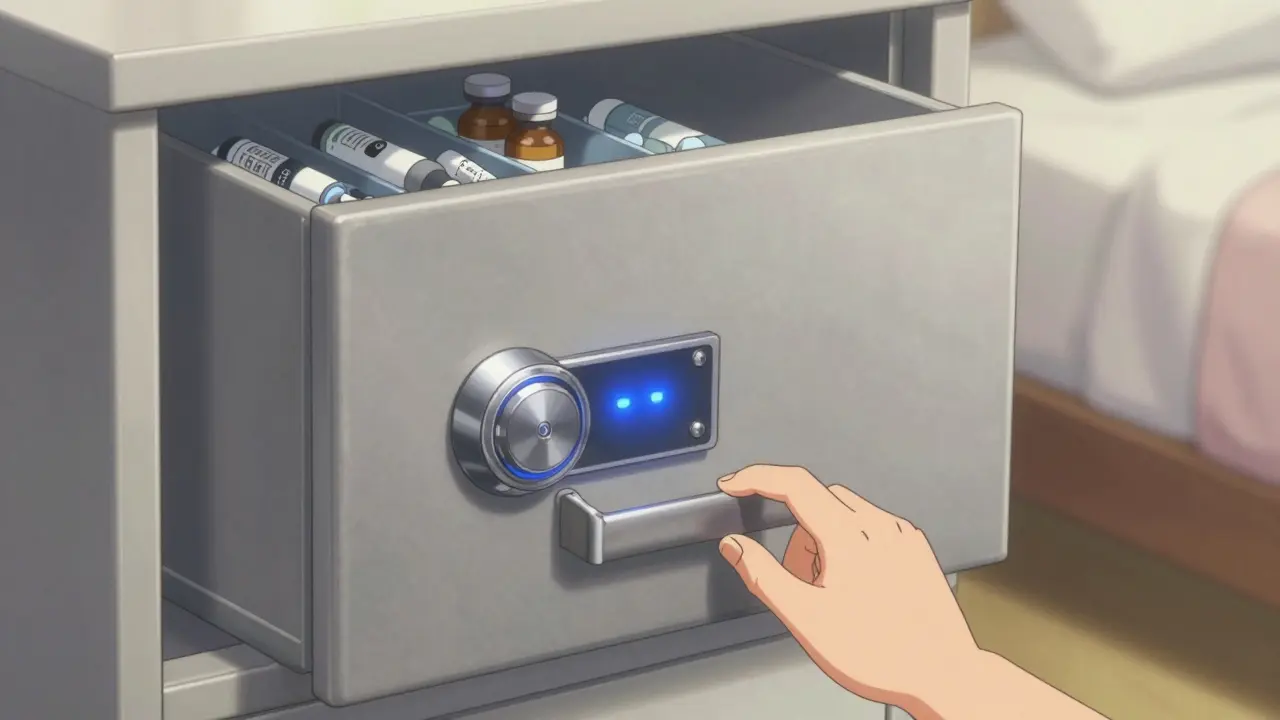
The safest place is a locked box-out of sight, out of reach. It doesn’t have to be fancy. A simple lockable cabinet, a small safe, or even a locked drawer in a bedroom dresser works. The key is that it must require a key or code to open. Child-resistant caps aren’t enough. By age five, half of all kids can open them. That’s not a safety feature-it’s a false sense of security.
Look for storage spots that are already secure. Many households already have locked cabinets for guns, tools, or valuables. Use one of those. If you have a fireproof document box, that’s perfect. Even a locked filing cabinet in the bedroom is better than the bathroom. The goal isn’t luxury-it’s access control.
For medicines that need to be refrigerated-like insulin, certain antibiotics, or eye drops-keep them in a locked section of the fridge, away from food. Don’t put them on the top shelf where kids can reach. Use a small plastic bin with a latch and label it clearly. This keeps them cold and safe.
What Makes a Good Storage Solution?
You don’t need to spend hundreds. Basic medication safes cost between £15 and £120. Look for ones that meet Underwriters Laboratories standards-they’re tested to resist at least 50 pounds of force. That means a child won’t be able to pry it open. Avoid flimsy plastic boxes with simple latches. They’re not locks-they’re suggestions.
Original packaging matters. Never transfer pills to empty jars or pill organizers unless you’re using them for daily doses. Keep the bottle with the label: National Drug Code, expiration date, dosage instructions. If you’re giving medicine to a child, use a syringe or measuring cup-not a teaspoon. And always put it back in the locked container right after use. That five-minute window after taking your pill is when most accidents happen.
For households with elderly members who have dementia, safety has to be balanced with accessibility. In those cases, a digital dispenser with a biometric lock or a timed release system can help. These devices only open at scheduled times and record who accessed them. They’re not for everyone, but they’re a proven tool when standard locking isn’t enough.
Common Myths About Medication Storage
Myth: “I keep my meds on a high shelf-it’s fine.”
Reality: Children climb. They pull chairs, stack books, use the couch. A 2022 CDC study showed that 48% of children under three can reach items on shelves higher than 40 inches. High doesn’t mean safe.
Myth: “My child isn’t curious. They won’t touch it.”
Reality: Kids explore by mouth. A pill looks like candy. A liquid looks like juice. Even if your child has never touched medicine before, curiosity doesn’t wait for a warning. One moment of distraction is all it takes.
Myth: “I only have a few pills. It’s not a big deal.”
Reality: A single dose of a strong painkiller or blood pressure pill can be deadly for a child. Even one aspirin can cause Reye’s syndrome. You don’t need a full bottle to cause harm.
What to Do With Old or Unused Medications
Don’t flush them. Don’t throw them in the trash. Both harm the environment and can still be accessed by others. In the UK, most pharmacies offer free medicine take-back programs. Bring your expired or unused pills to your local pharmacy-they’ll dispose of them safely. If you’re unsure where to go, check with your GP surgery or visit the NHS website for drop-off locations.
If you must store unused meds temporarily, keep them locked with your active medicines. Label them clearly as “expired” or “to dispose.” Don’t let them sit out. Even old pills can be dangerous if they fall into the wrong hands.
Special Cases: Grandparents, Visitors, and Multi-Generational Homes
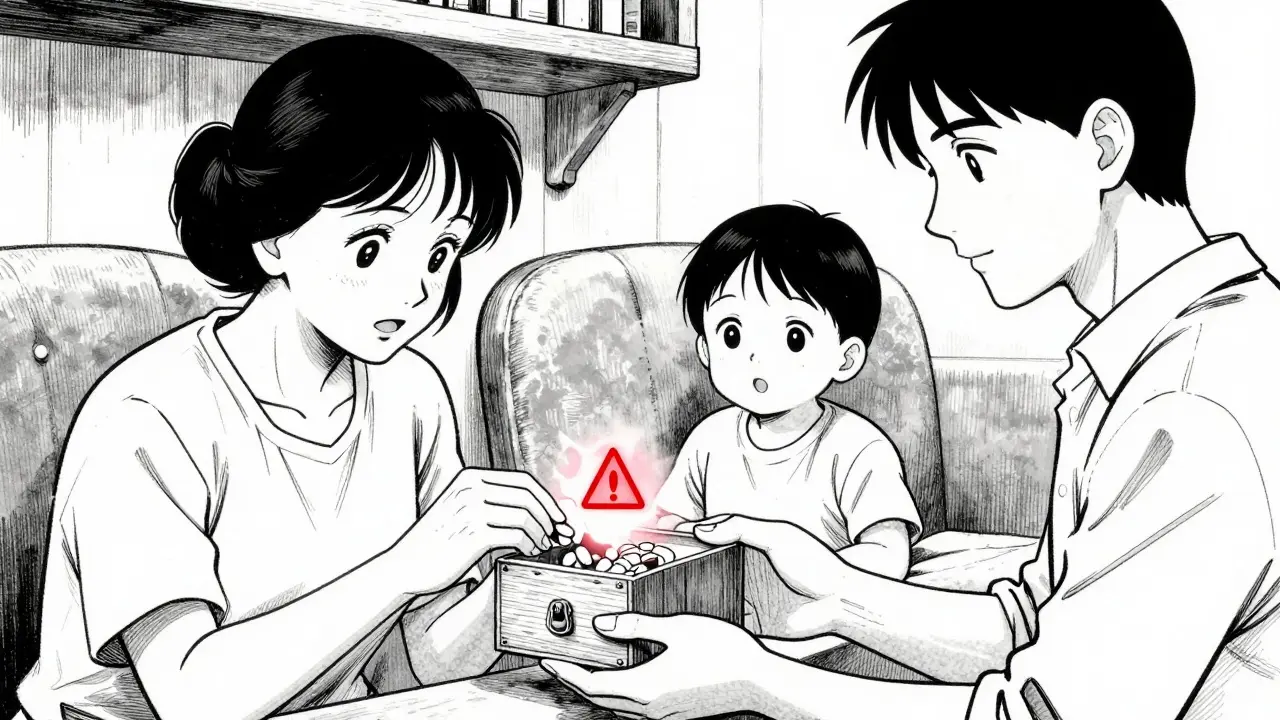
One in two poisoning cases happens in a grandparent’s house. Why? Because storage habits differ. Grandma keeps her pills in a drawer. Mom keeps hers locked. When the child visits, they find the unlocked drawer. That’s why it’s critical to talk to family members about storage. Ask: “Where do you keep your medicines?” Offer to help them get a small lockbox. It’s not about control-it’s about safety.
Same goes for visitors. If someone comes over with their meds, ask if they’d like to store them safely. Keep a small lockbox in a bedroom closet for guests. It’s polite, practical, and prevents accidents.
In homes with multiple adults, create a shared system. One locked box for everyone’s meds. Label each bottle with the person’s name. This avoids confusion and keeps everything contained.
How to Make This Routine
Make it part of your daily rhythm. After you take your morning pill, lock it away. After you give your child their medicine, lock it away. Put the key or code in the same place every day-don’t hide it where a child might find it, like under a plant or taped to the back of a drawer.
Set a reminder on your phone: “Lock meds after use.” Do it for a week. Soon, it’ll be automatic. Just like washing your hands or turning off the stove.
Teach older children too. Say: “These aren’t candy. They’re medicine. Only grown-ups can open them.” It’s not about scaring them-it’s about building respect for what’s dangerous.
And if you ever find your child with a pill in their mouth, don’t wait. Call 999 immediately. Don’t try to make them vomit. Don’t wait to see if they look sick. Time matters. The sooner help arrives, the better the outcome.
Safe storage isn’t about being paranoid. It’s about being smart. You lock your doors. You use child locks on cabinets. You don’t leave knives where kids can grab them. Medications are just as dangerous. Treat them the same way.
Every locked box is a life saved. Not just for your child. For the neighbor’s child. For your grandchild. For the next visitor who walks into your home. You don’t need to be perfect. You just need to be consistent.
Can I store medications in the kitchen?
Yes, but only if it’s in a locked cabinet away from food and moisture. The kitchen isn’t ideal because of steam from cooking and spills, but a high, locked cupboard is better than the bathroom or countertop. Avoid storing near the sink or stove.
Are child-resistant caps enough to keep kids safe?
No. While child-resistant caps are required by law, they’re not child-proof. Studies show half of children can open them by age five. They slow kids down, but they don’t stop them. Always pair them with a locked storage container.
What if I live in a small apartment with no extra storage?
You don’t need much space. A small lockbox that fits on a shelf or inside a closed drawer works. Even a locked toolbox or a fireproof document box can hold your meds. The goal isn’t size-it’s access control. If it locks, it’s better than leaving pills out.
Should I store my partner’s or family member’s medications with mine?
Yes, if they’re all kept in one locked container. This reduces clutter and makes it easier to monitor what’s inside. Just label each bottle clearly with the person’s name. It’s safer than having multiple unlocked spots around the house.
How do I dispose of old or expired medications safely?
Take them to your local pharmacy. Most NHS pharmacies offer free take-back programs. Never flush pills or throw them in the trash-this pollutes water and can be dangerous if someone finds them. If you’re unsure where to go, call your GP or visit the NHS website for drop-off locations near you.

Write a comment
Your email address will not be published.
Recent Posts
-
 Super Avana vs Alternatives: Dapoxetine and Avanafil Compared November 18, 2025


9 Comments
Just locked my meds in a small safe I got for $20 on Amazon. Best decision ever. My niece tried to open my drawer last week-she’s two. Thank god I didn’t leave them in the bathroom like I used to. Now it’s automatic: take pill, lock it. No thinking needed.
It is, indeed, a matter of considerable public health import that pharmaceutical substances are stored in a manner befitting their potential lethality. The casual disposition of potent compounds in domestic environments constitutes, in my estimation, a grievous dereliction of parental and custodial duty. One must not conflate convenience with safety; the former is the province of the negligent, the latter the domain of the responsible adult.
I never thought about how humid the bathroom is until I read this and now I’m like oh my gosh I’ve been keeping my thyroid meds in there for years and I just realized my pills taste weird sometimes and also my toddler climbed on the counter yesterday and I swear I didn’t even see her do it but she was standing there holding my ibuprofen bottle like it was a toy and I just froze I didn’t know what to do
Locked box. Not the bathroom. Not the purse. Done.
I’ve started keeping all meds in one locked drawer with labels. My partner’s blood pressure pills, my antidepressants, even the kids’ cough syrup. It’s less chaotic and honestly less stressful. I used to have stuff everywhere and now I just know where it is and who can get to it.
Have you ever wondered why the government doesn’t force everyone to use biometric locks on medicine? They know how many kids die every year from accidental overdoses… and yet they let pharma companies push child-resistant caps like they’re magic shields. It’s not negligence-it’s systemic. They want you to think you’re safe with a flimsy cap while the real solution-locked containers-is ignored because it’s not profitable. And don’t get me started on how pharmacies make you pay to return expired meds…
There’s a deeper metaphysical truth here: we treat medicine like a commodity, not a sacred trust. We leave it out like a coffee mug because we’ve forgotten that it carries the weight of life and death. The bathroom cabinet isn’t just a poor storage choice-it’s a symbol of our spiritual laziness. We outsource safety to convenience. We delegate responsibility to caps and shelves. But a child doesn’t care about your rationale. A child only sees color, shape, sweetness. And if you’re not guarding it with ritual, you’re inviting chaos into your home.
It’s fascinating how we’ve normalized the risk. We don’t think twice about leaving a bottle on the nightstand because we’re ‘just going to the kitchen for a minute.’ But that minute is the exact window where a child’s curiosity becomes catastrophe. And we don’t even notice the pattern-until it’s too late. We assume our child is ‘not the type’ to touch things, but curiosity isn’t a personality trait-it’s a biological drive. Every child is a little scientist. And if you leave pills on the table, you’re basically handing them a lab sample. The real question isn’t ‘how to store meds’-it’s ‘how do we unlearn our assumptions about danger?’
My wife and I started using a locked box after our neighbor’s grandkid nearly died from grabbing a blood pressure pill. It’s not about being paranoid-it’s about being prepared. We got a cheap one from Walmart, put it on the top shelf of our closet, and now it’s part of our routine. We even got one for my mom’s house-she’s 78 and kept her pills in a cereal box on the counter. I showed her this post and she cried. Said she never realized how dangerous it was. You don’t need a fancy system. You just need to care enough to lock it. And if you’re visiting someone? Ask. Don’t assume. Say ‘Where do you keep your meds?’ That one question could save a life.