

Every year, more than 100,000 people in the U.S. die from drug overdoses. Most of those deaths involve opioids - especially fentanyl - and many happen at home, in front of family members who don’t know what to do. The good news? You can change that. With a simple, well-prepared family overdose emergency plan, you can turn panic into action and potentially save a life in under five minutes.
Why This Plan Isn’t Just Helpful - It’s Essential
If someone in your home takes prescription pain medication, you’re not just managing a health condition. You’re living with a risk. In 2022, over 51 million U.S. adults received an opioid prescription. And while most use them safely, even one mistake - taking too much, mixing with alcohol, or using after tolerance drops - can lead to overdose. The clock starts ticking the moment breathing slows. Brain damage can begin in under three minutes. Death can follow in six. This isn’t about fear. It’s about readiness. Studies show that when naloxone - the overdose-reversing drug - is given within the first few minutes, it works 93% of the time. But only if someone knows how and where to find it. Most families don’t. Only 12.3% of U.S. households with prescription meds have a plan. That’s not luck. That’s a gap you can close.Step 1: Know the Signs of an Overdose
You can’t respond to what you don’t recognize. Overdose doesn’t always look like someone slumped over with a needle in their arm. It’s quieter. More subtle. Here’s what to look for:- Unresponsive: Shake their shoulder hard. Call their name. If they don’t wake up, it’s not sleep - it’s overdose.
- Shallow or stopped breathing: Count breaths for 15 seconds. If they take fewer than 12 breaths per minute, or if their chest isn’t moving, it’s an emergency.
- Pinpoint pupils: Look at their eyes. If the black center is tiny like a pinprick, that’s a classic sign of opioid overdose.
- Blue or gray lips/fingertips: This means their body isn’t getting enough oxygen.
Step 2: Get Naloxone - And Keep It Accessible
Naloxone (brand names Narcan, Kloxxado, or generic nasal spray) is the only medication that can reverse an opioid overdose. It’s safe, non-addictive, and works even if you’re not sure what drug was taken. It doesn’t harm someone who didn’t overdose. Where to get it: You don’t need a prescription in 46 states. Walk into any CVS, Walgreens, or local pharmacy and ask for naloxone. Many offer it for $25 or less with insurance. Some pharmacies give it out free. In New York City, over 287,000 free kits were distributed in 2023 alone. How many to keep: Get at least two doses. Fentanyl is so strong that one dose of naloxone often isn’t enough. Some people need three. Keep them together in one place. Where to store it: Not in the medicine cabinet. Not in the glove compartment. Keep it in a drawer or pouch you can find in the dark, with a bright label. Make sure it’s at room temperature (68-77°F) and away from sunlight. Check the expiration date every 18 months. Naloxone doesn’t suddenly stop working, but its effectiveness drops over time.Step 3: Build Your Step-by-Step Response Plan
Write this down. Print it. Tape it to the fridge. Laminate it. Make sure every adult and teen in the house knows where it is and what to do. Use the A.N.C.H.O.R. protocol - it’s simple, proven, and taught by emergency responders:- Assess: Check for unresponsiveness, slow breathing, blue lips. Don’t wait.
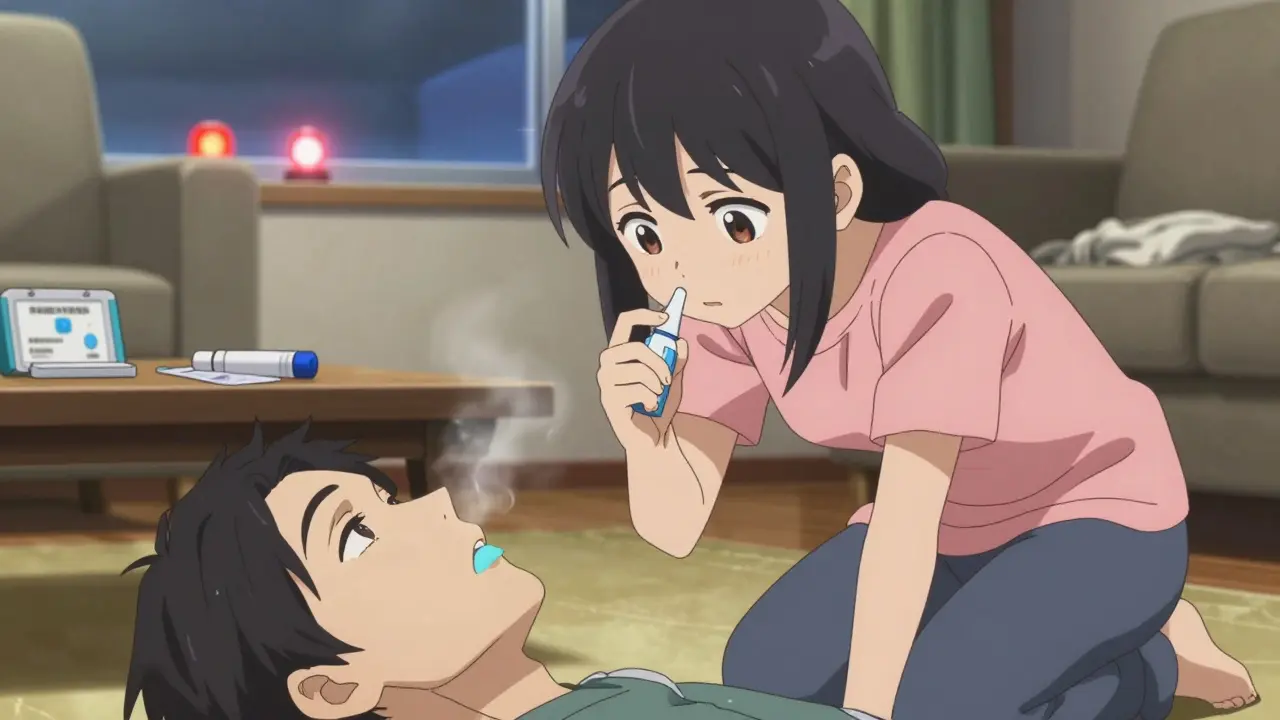
- Naloxone: Administer one dose of nasal spray into one nostril. If you have a syringe, inject it into the thigh muscle. No need to remove clothing - just lift the shirt.
- Call 911: Do this immediately after giving naloxone. Say: “Someone has overdosed on opioids. I’ve given naloxone. They’re not breathing.”
- Have more ready: If they don’t wake up in 3-5 minutes, give a second dose. Keep the second kit open and ready.
- Observe: Stay with them. Even if they wake up, they can relapse into overdose. The effects of naloxone wear off faster than opioids. Keep monitoring for at least two hours.
- Review: After the crisis, talk as a family. What worked? What didn’t? Update your plan.
Step 4: Train Everyone - Especially Teens
You might think only adults should handle this. But in 34% of households where a teen has witnessed an overdose, they were the first to respond. Kids as young as 14 have saved lives. Practice with your family. Use a training kit (many pharmacies give them out for free). Watch a 15-minute video from the American Red Cross - it’s free online. Do a 10-minute drill every month. Make it normal. Like checking the smoke detector. Teach them how to call 911 clearly: “My mom/dad is not waking up. They’re not breathing. I gave them the nasal spray.”Step 5: Keep a Medication List and Emergency Contacts
When EMS arrives, they need to know what was taken. Write down:- All prescription medications taken in the home (names and doses)
- Who each medication belongs to
- Prescribing doctor’s name and phone number
- Emergency contacts: family, neighbor, local pharmacy
What This Plan Won’t Fix - And What You Should Do Next
A family overdose plan doesn’t treat addiction. It doesn’t replace therapy or recovery support. But it buys time. And time saves lives. Naloxone gives you a second chance. And 89% of people who survive an overdose with naloxone go on to seek treatment. That’s not a coincidence. It’s because they were given the chance to live. If someone in your home is struggling with opioid use, talk to their doctor. Ask if they can prescribe naloxone at the same time as the pain medication. Many doctors still don’t offer it - but they should. The CDC now recommends co-prescribing naloxone for any opioid dose over 50 morphine milligram equivalents (MME). That’s about 10 pills of 5mg oxycodone per day.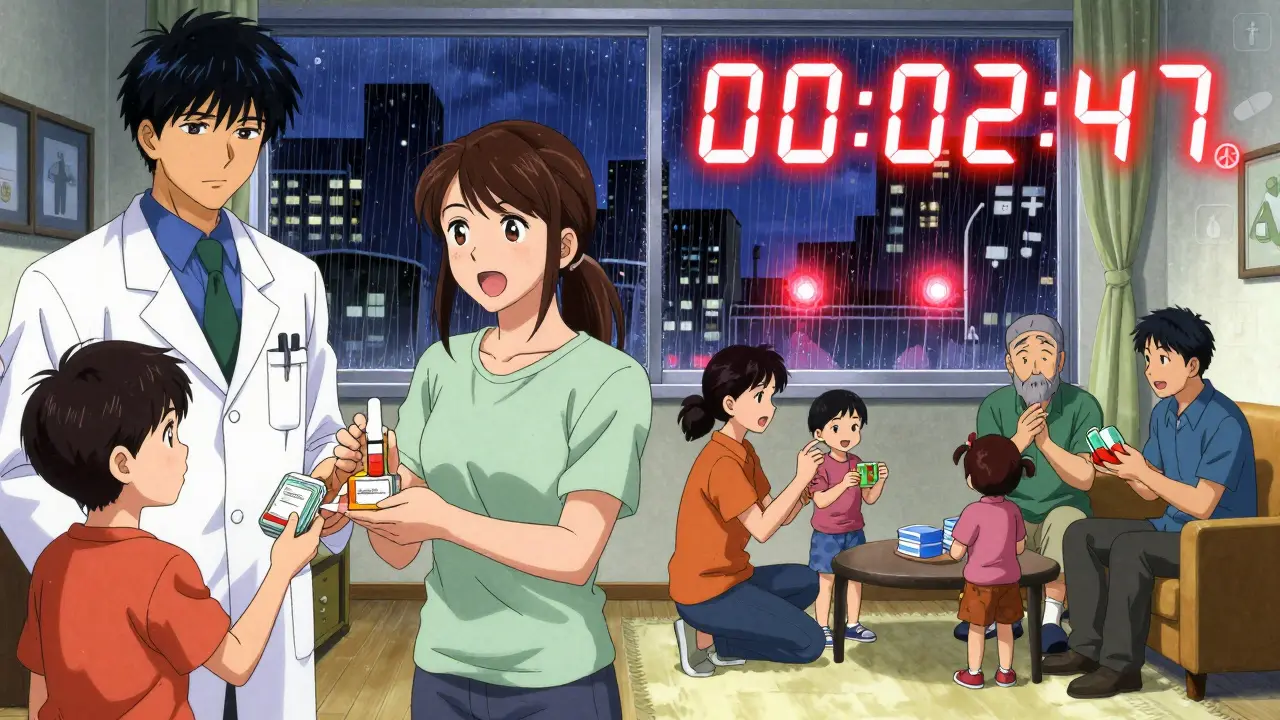
Common Mistakes - And How to Avoid Them
- Expired naloxone: 31% of failed rescues involved outdated kits. Set a phone reminder every 18 months.
- Wrong administration: 24% of users didn’t spray deeply enough into the nose. Make sure the nozzle is fully inserted and you press the plunger all the way.
- Waiting too long to call 911: 63% of preventable deaths involved delays. Call as soon as you give naloxone - don’t wait to see if it works.
- Thinking it’s “just sleeping”: 19% of families ignored signs because they didn’t want to believe it. Trust your gut. Better to act and be wrong than wait and lose someone.
What’s Changing - And Why It Matters
In 2024, the federal government made it easier than ever:- Medicare Part D now covers naloxone with $0 copay.
- Generic naloxone nasal spray costs 35% less than brand-name Narcan.
- 46 states allow pharmacy access without a prescription.
- Federally funded health centers must offer overdose plans by late 2025.
Final Thought: This Isn’t About Fear. It’s About Love.
Creating a plan doesn’t mean you expect someone to overdose. It means you love them enough to be ready if they do. It means you won’t stand by helpless. You’ll act. Fast. Confident. With a plan. You don’t need to be a doctor. You don’t need special training. You just need to know what to do - and where to find the spray. Start today. Get the naloxone. Talk to your family. Practice the steps. Write it down. Laminate it. Put it on the fridge. Because the next time someone stops breathing, you won’t be asking what to do. You’ll already know.Can I get naloxone without a prescription?
Yes. In 46 states, you can walk into a pharmacy like CVS or Walgreens and ask for naloxone without a prescription. Many pharmacies offer it for $25 or less with insurance, and some give it out for free. Check your local health department website for free distribution sites.
Is naloxone safe to use if I’m not sure it’s an opioid overdose?
Yes. Naloxone only works on opioids. If someone didn’t take opioids, it won’t hurt them. It won’t wake them up - but it won’t cause harm either. If they’re unresponsive and not breathing, give it anyway. The risk of doing nothing is far greater.
How long does naloxone last, and can the overdose come back?
Naloxone works for 30 to 90 minutes. But many opioids - especially fentanyl - last much longer. That means the person can slip back into overdose after naloxone wears off. That’s why you must monitor them for at least two hours and call 911, even if they wake up.
Can teens use naloxone safely?
Yes. Teens as young as 14 have successfully reversed overdoses. Many schools and youth programs now train students. Practice with them. Make sure they know where the kit is and how to call 911 clearly. Confidence matters more than age.
What if I’m afraid to talk about this with my family?
Start small. Say: “I read that fentanyl is in so many pills now, and I want us to be ready, just in case.” You’re not predicting disaster - you’re preparing for safety. Most families say they wish they’d done it sooner. Talking about it is the first step to saving a life.
Does insurance cover naloxone?
Most insurance plans, including Medicare Part D, cover naloxone with $0 copay as of 2024. Private insurers vary - some still charge $25-$50. If you’re denied, ask your pharmacy for the generic version or visit a free distribution site through your local health department.
How often should I check my naloxone kit?
Check the expiration date every 18 months. Store it at room temperature, away from direct sunlight. Even if it hasn’t expired, replace it if it’s been exposed to extreme heat or cold. Keep a spare kit in your car or bag if someone spends time away from home.

Write a comment
Your email address will not be published.
Recent Posts
-
 Tracking Lot Numbers and Recalls: What Patients Should Do Now November 19, 2025
14 Comments
Naloxone should be as common as fire extinguishers in every home. I keep two kits in my kitchen drawer-one by the coffee maker, one by the fridge. My teens know exactly where they are and how to use them. We practiced last month with the training spray. No drama, no panic-just muscle memory. If you’re not prepared, you’re gambling with someone’s life, and that’s not love, that’s negligence.
Stop pretending this is about love. This is corporate propaganda. Naloxone is a Band-Aid on a gunshot wound. The real problem? The pharmaceutical industry pushed opioids for decades, then turned around and sold us the antidote like it’s a subscription box. They profit either way. And now they’re making families feel guilty if they don’t buy the spray. Wake up.
Wow. So now we’re supposed to turn our homes into emergency response stations? I get the intent, but let’s be real-most families can’t even find the spare batteries for the smoke alarm. You want people to save lives? Start with free training in schools, not guilt trips on Reddit. And no, I’m not keeping naloxone in my sock drawer. That’s just asking for a kid to spray it on their cat.
Let’s not romanticize this. The ‘A.N.C.H.O.R.’ protocol sounds nice on paper, but in real life, panic doesn’t care about acronyms. I’ve seen three overdoses. One person was revived. Two died. The difference? One had a family who’d practiced. The others had a bottle of pills and a prayer. This isn’t about preparedness-it’s about systemic failure. We treat addiction like a moral flaw instead of a chronic disease. Naloxone is a tool, not a solution. And if you think this plan fixes anything, you’re missing the entire forest for the trees.
It’s heartening to see such practical guidance. In the UK, naloxone is available over the counter, but awareness is still low. I’ve shared this with my local community center. We’re organizing a free training night next month-no cost, no judgment. Just facts, practice, and a cup of tea. Sometimes, the simplest acts-like teaching someone to call 911 clearly-can be the most powerful.
How dare you normalize this? In India, we don’t need Western guilt trips about overdoses. Our families don’t hoard pills like collectibles. We don’t turn our homes into pharmacies. This is a symptom of moral decay-where people treat medicine like candy and then expect the state to clean up their mess. If your child is taking opioids, maybe you should’ve raised them better. This plan is a crutch for bad parenting and poor choices.
Thank you for this. I’m a nurse in Mumbai and I’ve seen so many cases where families didn’t know what to do. I printed this out and shared it with my community. We don’t have naloxone here easily, but we can still learn the signs. I told my neighbors: if someone’s not breathing, shake them, call for help, don’t wait. Sometimes, that’s all you need to do. ❤️
Minor correction: The CDC recommends co-prescribing naloxone for doses over 50 MME, but many prescribers still don’t. Also, the 93% efficacy rate applies only when administered within 3 minutes-after that, it drops sharply. And please stop calling it ‘Narcan’ generically; that’s a brand name. It’s naloxone. Precision matters. Also, the expiration date is 36 months for newer formulations, not 18. Check the label.
I’ve been giving these talks at my church for two years now. We keep naloxone in the fellowship hall, right next to the coffee urn. We’ve trained 14-year-olds, 70-year-olds, everyone. One woman told me she used it on her grandson last winter. He’s now two years sober. This isn’t about fear. It’s about showing up-for each other. No one should die because someone was too scared to act.
Oh sweet mercy. Another performative savior post. You didn’t save anyone. You just bought a nasal spray and posted about it like it’s a new yoga mat. Real people don’t laminate emergency plans. Real people are too busy working two jobs and paying for insulin to worry about whether their kid’s pupils are pinpoint. This is virtue signaling dressed as public health. And honestly? It’s exhausting.
Just got back from the pharmacy. Got two kits for $12 cash. No ID, no questions. The pharmacist said, ‘I’ve seen too many funerals. Take two.’ I’m keeping one in my car, one at my mom’s house. She’s on long-term pain meds. We’re doing a drill this weekend. No drama. Just action. This isn’t a trend. It’s a responsibility.
i just read this and cried. my brother overdosed last year. we had no idea what to do. we called 911 but we were too scared to touch him. i wish i had known then. i just ordered two naloxone kits. i’m telling everyone i know. thank you for writing this
The ethical imperative to equip families with naloxone is not merely pragmatic-it is a moral obligation of a society that purports to value human life. The institutional failure to universally disseminate this intervention reflects a deeper epistemological neglect of public health as a collective good. One cannot, in good conscience, advocate for the sanctity of life while simultaneously denying access to a proven, non-invasive, and cost-effective antidote. The time for passive benevolence has expired; the era of active, structured, community-based preparedness is now.
They’re not telling you the truth. Naloxone doesn’t reverse overdoses-it just buys time so they can arrest the person later. The whole thing’s a trap. Fentanyl’s in everything now because the government wants to depopulate the poor. You think they really want you to save someone? Nah. They want you to keep using so they can lock you up. And that spray? Probably laced with microchips. I’ve seen it on the dark web.