

Ever looked at a pill bottle and felt like you needed a medical degree just to figure out how to take your medicine? You aren't alone. Many people struggle with the tiny print and confusing jargon on their prescriptions. It sounds like a small thing, but misreading a label can lead to serious mistakes. In the US, medication errors cause roughly 7,000 deaths every year. That is a staggering number, but the good news is that most of these mistakes are preventable if you know exactly what to look for.
Whether you are managing a chronic condition or just grabbing some cold medicine from the drugstore, knowing how to decode drug labels is a vital skill. The goal isn't just to follow directions-it is about ensuring your safety by understanding what is in the bottle, why you are taking it, and what warning signs to watch for. Here is everything you need to know to read your labels with confidence.
The Two Main Types of Labels
Not all labels are created equal. Depending on where you got your medicine, you will encounter two very different formats. One is designed for doctors and pharmacists, and the other is designed for you.
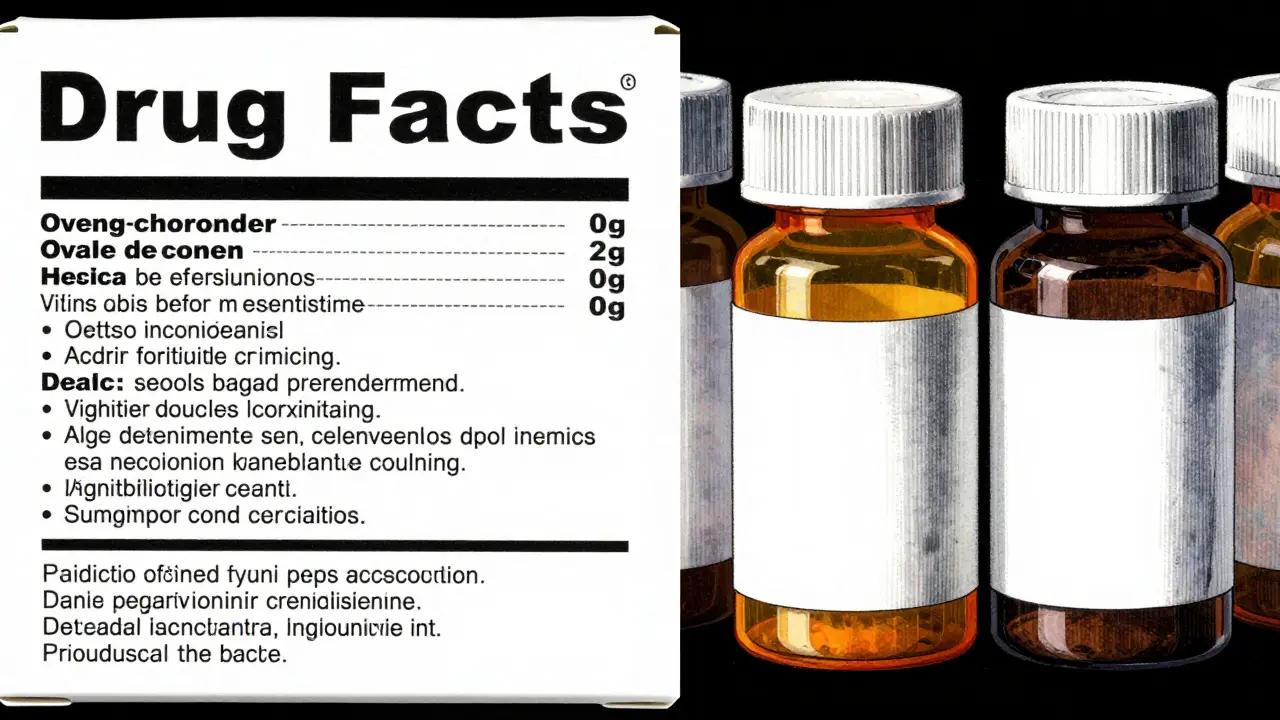
First, there are the labels for over-the-counter (OTC) medications. These use a standardized "Drug Facts" format. The FDA requires this layout so you can easily compare different brands of the same type of medicine. It is straightforward and focused on the basics: what is in it, what it does, and who should avoid it.
Then there are prescription labels. These are more complex because they involve the United States Prescribing Information (USPI). While the USPI is incredibly detailed, it is primarily written for healthcare providers. This is why many patients find the pharmacy-printed labels on the bottle confusing-they are often a condensed version of a document meant for a doctor, not a patient. This gap in communication is why a study found that only 36% of patients could correctly interpret standard prescription labels.
Decoding the "Drug Facts" Label (OTC)
When you pick up a bottle of ibuprofen or cough syrup, look for the "Drug Facts" box. It is broken down into specific categories to help you make a quick, safe decision.
- Active Ingredients: This is the most important part. It tells you the generic name of the drug that actually does the work. For example, if you see "Acetaminophen," you know it's a pain reliever, regardless of the brand name on the front of the box.
- Purpose: This explains what the active ingredient does, such as "nasal decongestant" or "antihistamine."
- Uses: This lists the specific symptoms the medicine is intended to treat. If your symptom isn't listed here, the medicine might not be the right choice for you.
- Warnings: This section is critical. It tells you if the medicine is unsafe for people with certain conditions (like high blood pressure) or if it interacts poorly with other drugs.
| Section | What it tells you | Example |
|---|---|---|
| Active Ingredient | The chemical that treats the problem | Guaifenesin |
| Purpose | The category of the drug | Expectoration |
| Uses | What symptoms it fixes | Loosens phlegm (mucus) |
| Warnings | Who should NOT take it | Do not use if you have a severe cough |
Breaking Down Your Prescription Bottle
Prescription labels are different because they contain personalized instructions from your doctor. However, they can still be overwhelming. To avoid mistakes, you should verify five key elements every time you pick up a script: your name, the medication name, the dosage instructions, the date it was filled, and the pharmacy's contact info.
You will often see two names for a drug. The trade name is the brand name (like Abstral), while the generic name is the actual drug (like fentanyl). Always keep track of the generic name; it helps you avoid accidentally taking two different brands of the same drug, which could lead to an overdose.
Then there is the strength and form. A label might say "100 mcg per tablet." The "100 mcg" is the strength, and "tablet" is the form. The route of administration-how you take it-is also listed, such as "sublingual" (under the tongue) or "oral" (by mouth). Taking a sublingual tablet by swallowing it might make the medicine less effective or change how it works in your body.
Red Flags: Common Labeling Pitfalls
Even if you are paying attention, some labels are designed in ways that lead to errors. One of the biggest culprits is "look-alike, sound-alike" (LASA) drugs. For instance, hydroxyzine and hydralazine sound very similar but do completely different things. To fight this, some pharmacies use "Tall Man Lettering," where part of the name is capitalized to highlight the difference (e.g., predniSONE vs. predniSOLONE). If you see this, pay extra attention to the spelling.
Abbreviations are another danger zone. You might see "q.d." on a label, which is shorthand for "once daily." However, the Institute for Safe Medication Practices (ISMP) notes that confusing abbreviations account for about 15% of labeling errors. If you see a code or a shortcut you don't recognize, do not guess. Call your pharmacist immediately.
Finally, watch out for the expiration date. Medications don't always become toxic the day they expire, but they can lose their potency. Using an expired antibiotic, for example, might not be strong enough to kill the infection, which can lead to antibiotic resistance.
How to Advocate for Your Own Safety
If you find yourself squinting at a label or feeling confused, the responsibility shouldn't be entirely on you. Research shows that when a pharmacist verbally explains the label, medication errors drop by 29%. You have the right to a clear explanation of your medication.
When you are at the pharmacy counter, ask these specific questions:
- "What is the reason I am taking this specific medication?" (Adding the indication to a label can reduce errors by up to 42%).
- "Are there any foods or other drugs I should avoid while taking this?"
- "What should I do if I miss a dose?"
- "Can you show me exactly how to use this device or measure this dose?"
For those with vision impairment or difficulty reading small print-which affects over half of Medicare beneficiaries aged 65+-don't be afraid to ask for large-print labels. Many pharmacies can accommodate this request to ensure you aren't guessing at your dose.
What's Changing in the Future?
The Food and Drug Administration (FDA) is finally moving toward more "patient-centered" labeling. In the past, the FDA focused on informing doctors, but they are now developing Patient Medication Information (PMI) documents. These are intended to be one-page, standardized guides that are much easier for a regular person to read than the dense USPI documents.
We are also seeing the rise of Instructions for Use (IFU) documents. Instead of just saying "inject once weekly," these guides provide step-by-step visual instructions on how to prepare the drug, handle the needle, and dispose of the waste safely. These changes are part of a broader strategic plan to make medication labels a tool for health rather than a source of confusion.
What is the difference between a generic name and a trade name?
A generic name is the official chemical name of the active ingredient (e.g., ibuprofen), while a trade name is the brand name given by the manufacturer (e.g., Advil). Both contain the same active ingredient, but the trade name is used for marketing.
What should I do if I can't read the small print on my prescription?
You should ask your pharmacist for large-print labels. Many pharmacies can provide this service to help prevent dosing errors, especially for elderly patients or those with visual impairments.
Why is the "Indication for Use" important on a label?
The indication is the reason why the medicine was prescribed (e.g., "for high blood pressure"). Research indicates that having this on the label can reduce medication errors by up to 42% because it confirms the patient is taking the right drug for the right reason.
What are "Tall Man" letters?
Tall Man lettering is a technique used to highlight the differences between look-alike drug names. For example, writing "predniSONE" and "predniSOLONE" helps pharmacists and patients distinguish between two different medications that look nearly identical on paper.
Can I trust the "Highlights" section of a prescription drug insert?
The Highlights section provides a quick summary of the most important information, but the FDA explicitly states it should not be used as a stand-alone document. You should always review the Full Prescribing Information or consult your pharmacist for the complete picture.
Next Steps for Your Medication Safety
If you are managing multiple medications, the best thing you can do is create a personalized medication list. Don't rely solely on the bottles. Write down the generic name, the dose, the time of day you take it, and the reason why you take it. This list is a lifesaver during emergency room visits or when switching doctors.
If you are a caregiver for an elderly parent, take a moment to audit their medicine cabinet. Check for expired drugs and look for any overlapping medications (where they might be taking two different brands of the same generic drug). When in doubt, bring all the bottles to the pharmacist for a "brown bag" review to ensure everything is safe and necessary.

Write a comment
Your email address will not be published.
Recent Posts
-
 Anhydrous Crystalline Maltose: Boost Energy & Stamina in Your Diet September 22, 2025

11 Comments
I totally agree that having a personalized list is a great idea. I've started doing that for my mom and it really helps us stay organized during doctor visits!
The banal obsession with "simplifying" information is precisely why modern society is decaying into a state of intellectual atrophy. One does not simply "decode" a label; one engages with the clinical reality of pharmacology. To demand a one-page summary is to admit a failure of basic literacy and a refusal to engage with the complexity of biological existence.
Honestly, the whole "Tall Man Lettering" thing is such a joke. It looks like a typo from a middle schooler's essay. Who actually thinks capitalizing a few letters makes a massive difference in a high-stress medical environment? Truly embarrassing for the industry.
It is so important to remember that every patient has a different level of comfort with medical jargon... please, please take the time to be patient with your loved ones!!! It makes a world of difference!!!
From a clinical perspective, the use of the "indication for use" on the label is the gold standard for reducing errors. Patients who understand the purpose of their medication are significantly more likely to adhere to the prescribed regimen and report adverse reactions promptly.
What a beautiful guide to help us stay healthy! It is a blessing to have such clear information to protect our families. :) ☀️
i realy feel for the people who cant read the labels, its so scary to think about taking the wrong pill because of small letters. it is truly a heartbraking situation for the elderly!!
Get your act together and stop guessing with your health! If you can't read the label, don't just sit there-demand a large-print version or make the pharmacist spell it out for you. No excuses when it comes to not overdosing on some random pill.
American pharmacies are the best. Superior standards. Period.
I've found that keeping a simple folder with all the original inserts helps me double-check things without feeling rushed at the pharmacy counter.
This is such a vibe! Just a little bit of extra attention to those labels can save so much stress. It's all about finding that balance and keeping things chill while staying safe. Love the idea of the "brown bag" review-so clever and simple!