

Why Sunscreen Isn’t Just for Beach Days
You don’t need to be lying on a beach to get damaged by the sun. Even on a cloudy day in Manchester, or while sitting near a window at your desk, UV rays are still hitting your skin. The truth is, daily sunscreen use isn’t optional-it’s as essential as brushing your teeth. But not all sunscreens are created equal. Understanding SPF, UVA, and UVB isn’t just science class stuff-it’s the difference between healthy skin and long-term damage.
What SPF Actually Means (And What It Doesn’t)
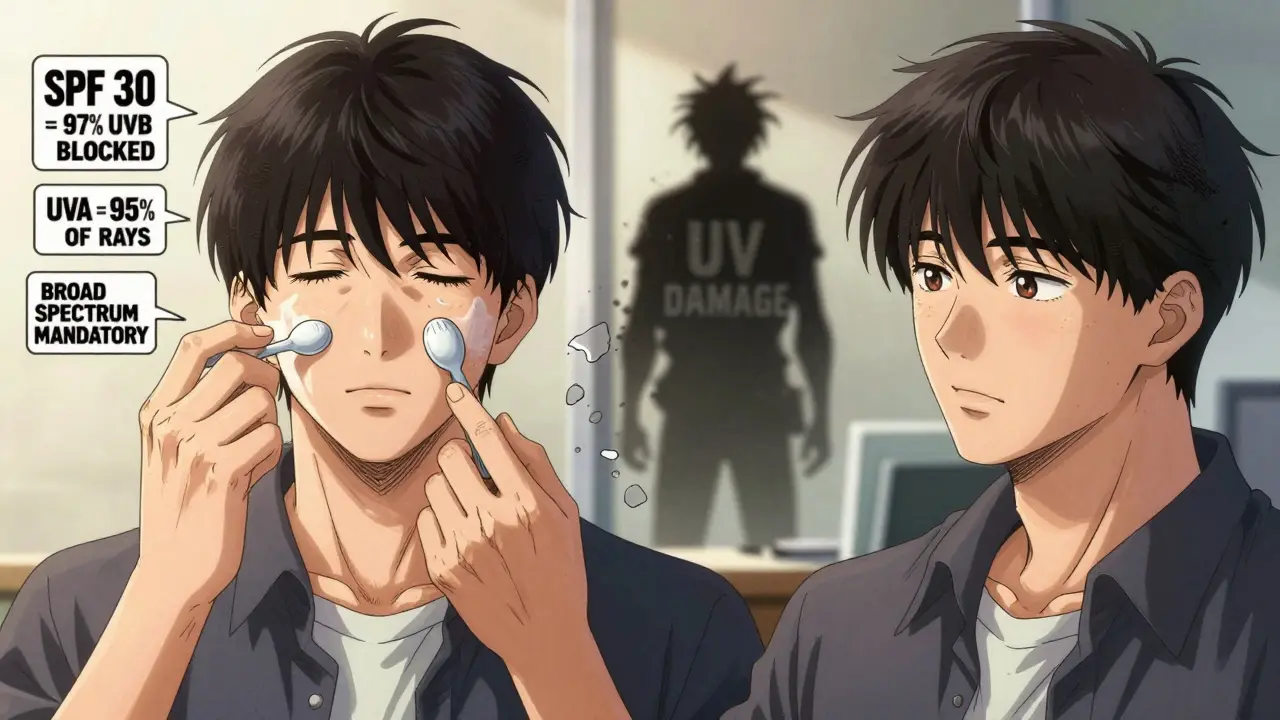
SPF stands for Sun Protection Factor, and it only measures protection against UVB rays-the ones that burn your skin. An SPF 30 sunscreen doesn’t mean you can stay out three times longer than without protection. It means it takes 30 times longer for your skin to redden compared to bare skin. But here’s the catch: SPF doesn’t increase linearly. SPF 15 blocks 93% of UVB rays. SPF 30 blocks 97%. SPF 50 blocks 98%. That last 1% might sound tiny, but it’s the difference between your skin slowly breaking down over years and staying protected.
The problem? Most people apply only a quarter of the amount they should. Dermatologists say you need about 1/4 teaspoon for your face alone. If you’re using half that amount, your SPF 30 drops to the protection level of SPF 15-or worse. That’s why experts recommend SPF 30 or higher: it gives you a buffer for under-application.
UVA vs. UVB: The Hidden Threat You Can’t Feel
UVB rays are the sunburn culprits. They’re strong between 10 a.m. and 4 p.m., and they’re the main cause of skin cancer. But UVA rays? They’re sneakier. They make up 95% of the UV radiation that reaches Earth. They don’t burn you-they age you. UVA penetrates deep into your skin, breaking down collagen and elastin, leading to wrinkles, dark spots, and sagging. And they don’t care if it’s winter, cloudy, or you’re indoors. UVA rays go through glass. Your car window, your office window-they’re not stopping them.
That’s why “broad spectrum” matters. A sunscreen labeled SPF 50 but not broad spectrum is giving you great burn protection but leaving your skin vulnerable to aging and deeper damage. The FDA requires broad-spectrum sunscreens to pass a test called critical wavelength, meaning they must block UVA rays up to at least 370 nanometers. The Skin Cancer Foundation now requires SPF 50+ products to have even stronger UVA protection-UVA-PFdx scores of at least 20-to match the higher SPF.
Mineral vs. Chemical: Which One Should You Use?
There are two main types of sunscreen: mineral and chemical. Mineral sunscreens use zinc oxide or titanium dioxide. They sit on top of your skin and physically block UV rays like a shield. They’re great for sensitive skin, less likely to cause breakouts, and start working immediately. But they can leave a white cast, especially on darker skin tones. Newer formulas have improved this, with micronized particles and tinted options that blend better.
Chemical sunscreens use ingredients like avobenzone, octinoxate, and octocrylene. They absorb UV rays like a sponge and convert them into heat. They tend to be lighter, easier to spread, and less likely to leave a white cast. But they need about 15 minutes to activate after application. Some people report stinging, redness, or breakouts-especially with oxybenzone, which has been flagged for potential irritation.
Reddit users in skincare communities report that 78% of those with sensitive skin saw fewer reactions switching to mineral sunscreens. But 63% complained about the white cast. On Amazon, top-rated sunscreens like La Roche-Posay Anthelios SPF 50 get high marks for being “no white cast,” meaning the industry is catching up. If you have acne-prone skin, try a mineral formula labeled “non-comedogenic.” If you hate the chalky look, look for chemical sunscreens with newer filters like Tinosorb or Mexoryl-common in European brands.
Water Resistance Isn’t Forever
Just because your sunscreen says “water resistant” doesn’t mean it lasts all day at the pool. The FDA only allows two labels: “water resistant (40 minutes)” or “water resistant (80 minutes).” After that, you need to reapply. Sweat, towel-drying, and swimming all remove sunscreen-even if it’s labeled “waterproof,” which isn’t even a legal term anymore.
And don’t forget: reapplying isn’t just for beach days. If you’re outside walking the dog, commuting, or working near a window, reapply every two hours. If you’re wearing makeup, use a mineral powder sunscreen or a sunscreen spray designed for reapplication over makeup. Don’t just slap it on top-blot first, then apply evenly.
What to Look for on the Label (And What to Ignore)
Here’s what actually matters:
- Broad spectrum - Non-negotiable. No UVB-only products.
- SPF 30 or higher - The Skin Cancer Foundation now recommends SPF 30+ for daily use, SPF 50+ for active days.
- Active ingredients - Check for zinc oxide, titanium dioxide, avobenzone, or newer filters like Tinosorb.
- Water resistance - Only if you’ll be sweating or near water.
Ignore these:
- “SPF 100+” - The FDA proposed capping labels at SPF 60+ because higher numbers mislead people into thinking they’re getting way more protection. The difference between SPF 50 and SPF 100 is less than 1%.
- “Sunblock” - That term is banned by the FDA. No product completely blocks UV rays.
- “Antioxidant-infused” - Nice bonus, but not a replacement for proven UV filters.

Real-World Mistakes (And How to Fix Them)
Most people mess up sunscreen in three ways:
- Applying too little - Use a full teaspoon for your face and neck. If it looks too thick, you’re probably still not using enough.
- Skipping days - Even in January, UV levels are high enough to cause damage. Make it part of your morning routine, right after moisturizer and before makeup.
- Forgetting ears, neck, and lips - These areas get overlooked. Use a lip balm with SPF 30+. Your ears? A quick swipe of sunscreen there too.
And if your sunscreen pills under makeup? Apply it as the last step in your skincare routine, wait 15 minutes, then add foundation. Avoid mixing it with heavy moisturizers or silicones-it’s a common cause of pilling.
The Bigger Picture: Why This Matters Beyond Beauty
Sunscreen isn’t about looking younger (though that’s a nice side effect). It’s about preventing skin cancer. The American Academy of Dermatology says one in five Americans will develop skin cancer by age 70. Most of those cases are preventable. UV radiation damages DNA in skin cells. That damage builds up over time. One bad sunburn in childhood can double your risk of melanoma later. Daily sunscreen use cuts your risk of squamous cell carcinoma by 40% and melanoma by 50%.
The global sunscreen market is growing fast-projected to hit $16.89 billion by 2030. That’s because more people are learning the science. Dermatologists now recommend sunscreen to every patient, and corporate wellness programs are starting to include sun protection. The FDA is cracking down on misleading labels. By December 2025, any sunscreen without clear “broad spectrum” labeling will be pulled from shelves in the U.S.
What’s Next? Blue Light and Beyond
The next frontier isn’t just UV. Dermatologists are starting to look at blue light from screens and infrared radiation from the sun. Early research suggests these can also contribute to skin aging. While no sunscreen currently blocks blue light effectively, some brands are adding antioxidants like vitamin C and ferulic acid to neutralize free radicals. In five years, we may see sunscreens that protect against UV, blue light, and even pollution.
For now, stick to the basics: broad spectrum, SPF 30+, daily use, proper amount, reapplication. You don’t need the fanciest bottle. You just need consistency.
Do I need sunscreen on cloudy days?
Yes. Up to 80% of UV rays penetrate cloud cover. UVA rays, which cause aging and skin cancer, are just as strong on overcast days. Daily sunscreen is meant for every day-not just sunny ones.
Can I rely on makeup with SPF instead of sunscreen?
Not reliably. Most makeup with SPF is applied too thinly to offer real protection. You’d need to use about seven times the normal amount of foundation to reach the labeled SPF. Use a dedicated sunscreen underneath your makeup.
Is higher SPF always better?
Not significantly. SPF 30 blocks 97% of UVB rays. SPF 50 blocks 98%. The extra 1% isn’t worth the cost or potential for irritation from more chemicals. Higher SPF can give a false sense of security, leading people to stay out longer or reapply less often.
Are mineral sunscreens safer than chemical ones?
Mineral sunscreens are less likely to irritate sensitive skin and start working immediately. Chemical sunscreens may cause reactions in some people, especially those with acne or rosacea. Both types are considered safe by the FDA. The choice depends on your skin type and preferences-not safety.
How often should I reapply sunscreen?
Every two hours when outdoors. If you’re sweating, swimming, or wiping your face, reapply immediately. Even indoors near windows, reapplying once midday helps if you’re exposed to sunlight for long periods.
Do I need sunscreen if I have dark skin?
Yes. While darker skin has more natural melanin protection, it’s not immune to UV damage. Skin cancer is often diagnosed later in people of color, leading to worse outcomes. UVA rays still cause aging and DNA damage. Broad-spectrum sunscreen is essential for everyone.

Write a comment
Your email address will not be published.
Recent Posts
-
 Buy Cheap Generic Claritin Online - Save on Allergy Meds October 10, 2025
 -
 Benzodiazepines and Birth Defect Risks: What Pregnant Women Need to Know February 23, 2026
 -
 Viramune (Nevirapine) vs. Other HIV Drugs: 2025 Comparison Guide October 6, 2025


13 Comments
SPF 50? More like SPF 50 fantasy. You think you're protected but you're just slathering on a fancy lotion and then spending 6 hours in the sun like a dumbass. I've seen people with peeling faces like they just survived a desert storm and they swear they 'used sunscreen.' Yeah, right.
The real tragedy isn't that we ignore UV radiation-it's that we've turned sun protection into yet another consumer ritual divorced from actual awareness. We buy products with fancy labels, chase after 'no white cast' as if it's a spiritual goal, and forget that the most effective sunscreen is still shade, clothing, and time spent indoors. The market thrives on our anxiety, not our understanding. We're not protecting our skin-we're performing protection.
Biggest thing I learned? It’s not about the SPF number. It’s about consistency. I used to skip it on cloudy days. Then I noticed my left cheek (the side facing the window at work) looked like a dried-out prune compared to the right. Now I slap it on every morning like brushing my teeth. No more weird asymmetry. Also, lip balm with SPF-game changer.
Mineral sunscreen is a nightmare on dark skin. The white cast looks like I forgot to wash my face. Just sayin'.
Also, why do brands still make SPF 100? It’s a scam.
Oh sweetie, you think you're being proactive? 😏
Let me guess-you use sunscreen but still get that 'sun-kissed glow' from tanning beds? 🤦♀️
And you're probably one of those people who thinks 'antioxidant-infused' means you can skip reapplying. Honey, no. No, no, no.
U.S. standards are the only ones that matter. Europe's Tinosorb? That's just fancy foreign junk. We got FDA-approved stuff here. If you're using some imported chemical crap, you're basically risking your skin for a 'lighter texture.' American science wins. Always.
Just a quick note-did you know that UVB is strongest between 10am and 4pm? But UVA? It's there all day, even at 7am on a rainy Tuesday. And yes, it goes through glass. I used to think my office window was safe... until I got a weird spot on my left shoulder. Now I wear sunscreen even when I'm working from home. Lesson learned the hard way 😅
While the article correctly identifies the non-linear efficacy curve of SPF, it neglects to address the photostability of active ingredients. Avobenzone, for instance, degrades under prolonged UV exposure unless stabilized with octocrylene or other photostabilizers. The critical wavelength metric is necessary but insufficient without context regarding molecular degradation kinetics. Furthermore, the FDA's 2025 labeling changes are procedural, not pharmacological-actual efficacy remains unregulated beyond the broad-spectrum threshold.
Really good info, i never knew uva goes through glass. I live in india, we think sun is only danger when its hot and bright. But now i use sunscreen even when i'm inside, near window. Also, i use zinc oxide cream, its thick but no white cast now with new formula. Thank you for this, i feel smarter now 🙏
SPF 30 is enough. Anyone who buys SPF 50+ is just wasting money. Also mineral sunscreen? For rich people who care about looking like ghosts. Chemical ones work fine if you're not a baby. Stop overcomplicating this. Sunscreen isn't rocket science.
Wait-so I’ve been doing it wrong this whole time? 😅
I thought if I used foundation with SPF, I was covered. Nope. I just spent $80 on makeup that’s basically a glorified primer. Time to buy real sunscreen and stop pretending I’m a skincare guru.
Everyone says broad spectrum but no one talks about how most brands just add a tiny bit of zinc and call it a day. The FDA test is a joke. I tested my 'broad spectrum' sunscreen with a UV meter. It blocked UVB fine but UVA? Barely. You're being sold a lie. Don't trust labels. Trust science. Or better yet-wear a hat.
Don’t forget your ears, your neck, your hands, your scalp if you have thinning hair, and your feet if you’re wearing sandals! UV damage doesn’t discriminate-it doesn’t care if you’re wearing a shirt or not. You need to treat your skin like the only one you’ve got. And yes, reapply-even if you’re just walking to your car. One missed spot could be the one that turns into a lesion later. Please. Be careful.