

When you swap a brand-name prescription for a cheaper generic, you trust that the two pills work exactly the same way in your body. But how do regulators actually prove that? For decades, pharmacokinetic studies have been treated as the gold standard for establishing this trust. Yet, calling them a "gold standard" is a bit of a misnomer. Regulatory agencies like the U.S. Food and Drug Administration (FDA) prefer to call it a "fundamental principle." It’s not about perfection; it’s about proving that a generic drug is similar enough to the original innovator product to be safely substituted.
This article breaks down what these studies actually measure, why the math behind them matters, and where they fall short. You’ll learn why some drugs need tighter testing rules, how new technologies are changing the game, and what this means for patient safety and healthcare costs.
The Foundation: What Pharmacokinetic Studies Actually Measure
To understand generic equivalence, you first need to understand pharmacokinetics. Simply put, it’s the study of what the body does to the drug. When you swallow a pill, your body absorbs it, distributes it through your blood, metabolizes it, and eventually excretes it. A pharmacokinetic study is a clinical trial designed to compare how quickly and how much of a drug enters the bloodstream from a generic versus a reference (brand-name) product.
These studies don’t usually test if the drug cures the disease-that was already proven during the original drug’s development. Instead, they focus on two critical metrics:
- Cmax (Maximum Plasma Concentration): This measures the peak level of the drug in your blood. If Cmax is too high, you risk side effects. If it’s too low, the drug might not work effectively.
- AUC (Area Under the Curve): This represents the total exposure to the drug over time. It tells regulators the overall extent of absorption.
If the generic drug hits your bloodstream at the same rate (Cmax) and stays there in the same amounts (AUC) as the brand-name drug, regulators consider them bioequivalent. This framework was established by the Hatch-Waxman Act of 1984, which created an abbreviated approval pathway for generics. This law allowed manufacturers to skip expensive preclinical safety trials, provided they could prove pharmaceutical and bioequivalence.
The Math Behind the Magic: The 80-125% Rule
You might wonder why regulators allow any difference at all. Why isn’t the target 100% identical? The answer lies in statistical reality. No two humans absorb drugs identically, even when taking the exact same pill. Therefore, regulators use a confidence interval rather than a single point estimate.
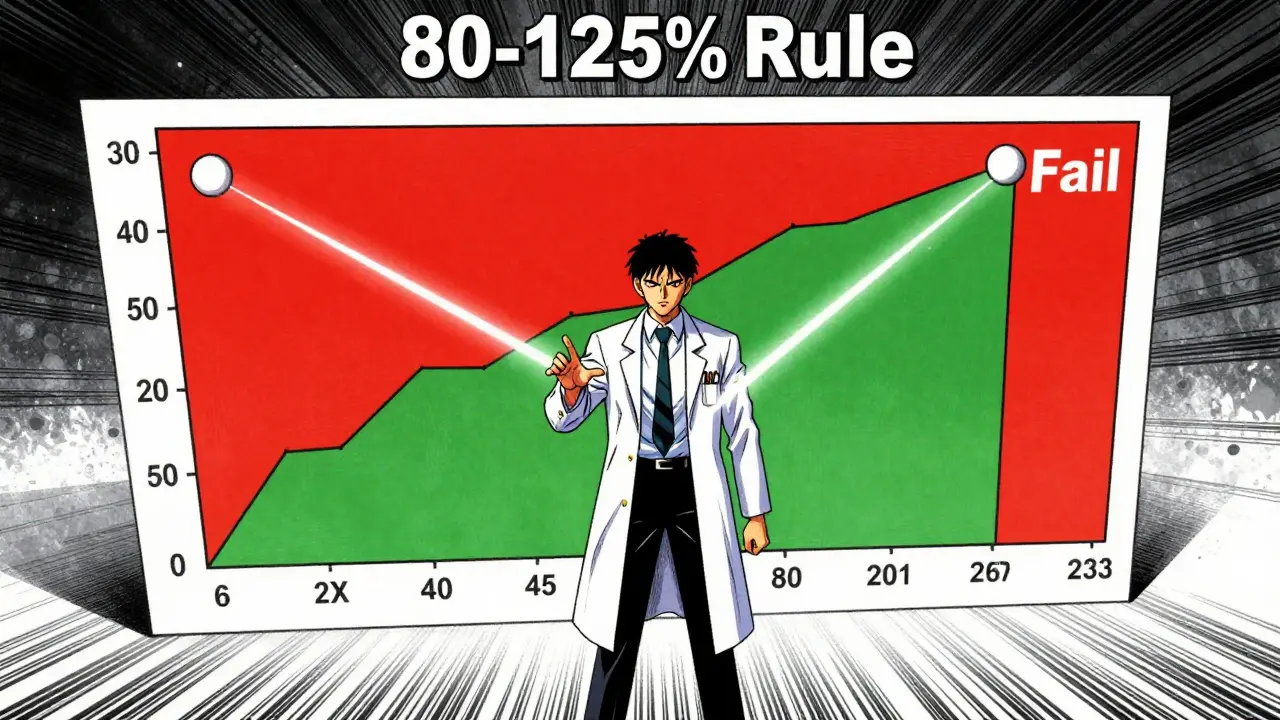
According to FDA guidance, the 90% confidence interval for the ratio of the generic to the reference product must fall within the range of 80-125%. Here is what that means in practice:
- If the generic delivers 95% of the drug compared to the brand, it passes.
- If it delivers 105%, it also passes.
- However, if the lower bound of the statistical calculation drops below 80% or the upper bound exceeds 125%, the generic fails.
This rule applies to most systemic immediate-release oral drugs. These are pills that dissolve quickly and release their active ingredient immediately upon ingestion. For these common medications, pharmacokinetic studies have proven highly reliable, with failure rates below 2% according to post-marketing surveillance data.
| Drug Type | Acceptable Confidence Interval | Primary Metric | Study Complexity |
|---|---|---|---|
| Immediate-Release Oral | 80-125% | Cmax & AUC | Low (24-36 subjects) |
| Narrow Therapeutic Index (NTI) | 90-111% | Cmax & AUC | Medium (Stricter limits) |
| Topical/Semisolid | Varies | Clinical Endpoint/Dermatopharmacokinetics | High (>500 subjects often needed) |
When the Rules Get Tighter: Narrow Therapeutic Index Drugs
Not all drugs are created equal. Some medications have a very small window between being effective and becoming toxic. These are called Narrow Therapeutic Index (NTI) drugs. Examples include warfarin (a blood thinner), phenytoin (for seizures), and digoxin (for heart conditions).
For NTI drugs, the standard 80-125% range is simply too wide. A slight variation in absorption could lead to serious health consequences. That’s why regulatory agencies require tighter equivalence limits for these products. Often, the 90% confidence interval must narrow to 90-111%.
Dr. Darrell Abernethy, former FDA Deputy Center Director for Clinical Pharmacology, has emphasized that bioequivalence is not just a regulatory hurdle but a critical patient safety imperative, especially for NTI drugs. As of 2023, the FDA issued specific guidance for 28 such drugs, requiring additional testing and stricter statistical controls. This reflects a growing recognition that while pharmacokinetic studies are powerful, they must be tailored to the specific risks of each medication.
Where Pharmacokinetics Fall Short: Complex Formulations
Here is where the "gold standard" label starts to crack. Pharmacokinetic studies work beautifully for simple pills. They struggle significantly with complex drug products. Think about topical creams, inhalers, or modified-release formulations that slowly release medication over 24 hours.
For topical products, measuring drug levels in the blood is often useless because the drug acts locally on the skin, not systemically. Frontiers in Pharmacology (2024) reports that comparative clinical endpoint studies for topical products typically require more than 500 subjects, making them impractical and prohibitively expensive for routine use.
In these cases, regulators look for alternatives. For instance, in vitro permeation testing (IVPT) using cryopreserved human skin has shown promise. Research by Lehman and Franz (2014) demonstrated that IVPT can be more accurate and less variable than traditional pharmacodynamic studies for semisolid drugs. Similarly, dissolution testing serves as a supplementary quality control measure, requiring ≤10% difference in dissolution profiles to be considered similar.
A stark example of pharmacokinetic limitations involves gentamicin generics. A PLOS ONE (2010) study documented cases where in vivo failure happened independently of the manufacturer’s prestige. Two generics from reputable makers showed identical in vitro results to the innovator product but had highly significant differences in pharmacodynamic profiles. This proves that pharmaceutical equivalence (same ingredients) does not always predict therapeutic equivalence (same effect).
The Cost and Timeline of Proving Equivalence
Proving a generic is equivalent is neither quick nor cheap. For manufacturers, demonstrating bioequivalence is often cited as "Pitfall 2" in generic development. Achieving this equivalence, particularly for complex formulations, presents a formidable scientific and technical hurdle.
As of 2023, the average cost of a single bioequivalence study ranges from $300,000 to $1 million USD. The timeline from formulation development to study completion typically takes 12-18 months. Despite these costs, this investment allows manufacturers to bypass the billions spent on original clinical efficacy trials, keeping generic prices low for consumers.
The global generic pharmaceutical market, valued at $467.2 billion USD in 2022, depends entirely on this regulatory framework. Without efficient bioequivalence pathways, the cost of generic drugs would skyrocket, impacting healthcare budgets worldwide.

Future Trends: Beyond Traditional Studies
The field of bioequivalence is evolving. Regulators are increasingly accepting alternative methodologies that reduce the burden on patients and manufacturers while maintaining safety. One major shift is the use of Physiologically-Based Pharmacokinetic (PBPK) modeling.
PBPK models use computer simulations to predict how drugs behave in the human body based on physiological parameters. Since 2020, the FDA has accepted PBPK models to support bioequivalence waivers for certain Biopharmaceutics Classification System (BCS) Class I drugs. These are drugs that are highly soluble and highly permeable, meaning they are almost guaranteed to be absorbed completely. Using models instead of human trials saves time and resources without compromising safety.
Additionally, dermatopharmacokinetic methods (DMD) are gaining traction for topical products. Recent research by Senemar et al. (2019) showed that DMD could discriminate differences in bioavailability with a power greater than 90%, potentially replacing large-scale clinical endpoint trials.
Regulatory Harmonization: Global Standards
While the FDA leads many innovations, bioequivalence is a global issue. The World Health Organization (WHO) defines therapeutic equivalence as requiring that two products have essentially the same effects regarding efficacy and safety. Approximately 50 national regulatory authorities worldwide have adopted requirements aligned with international standards.
However, discrepancies remain. The European Medicines Agency (EMA) has historically adopted a more conservative "one-size-fits-all" approach compared to the FDA’s product-specific guidelines. Dr. Alfredo García-Arieta of the Spanish Agency for Medicines and Medical Devices has highlighted these differences, noting they create challenges for global manufacturers trying to launch generics in multiple markets. Efforts through the International Council for Harmonisation (ICH), such as guideline ICH M13A, aim to standardize approaches for immediate-release products, currently adopted by 35 countries.
Are generic drugs really the same as brand-name drugs?
Generics contain the same active ingredient, strength, dosage form, and route of administration as the brand-name drug. They are required to be bioequivalent, meaning they perform similarly in the body. However, they may differ in inactive ingredients (like dyes or fillers), which rarely cause issues but can sometimes affect sensitivity in specific individuals.
Why is the bioequivalence range 80-125% and not 100%?
The 80-125% range accounts for natural variability in how different people absorb drugs. Statistical analysis shows that this range ensures the generic is therapeutically equivalent to the brand-name drug for the vast majority of patients. Tighter ranges are used for Narrow Therapeutic Index drugs where small changes matter more.
What happens if a generic fails a pharmacokinetic study?
If a generic fails to meet the bioequivalence criteria, it cannot be approved for sale. Manufacturers must reformulate the product-often adjusting excipients or manufacturing processes-and conduct new studies until the drug meets the strict statistical requirements set by regulatory agencies like the FDA or EMA.
Do all drugs require human trials for generic approval?
Most systemic oral drugs do require human pharmacokinetic studies. However, for certain complex products like topicals or inhalers, clinical endpoint studies or in vitro tests may be used instead. Additionally, highly soluble and permeable drugs (BCS Class I) may qualify for waivers using PBPK modeling, avoiding human trials altogether.
How much does it cost to develop a generic drug?
The cost varies widely but generally ranges from $1 million to $4 million per product, significantly less than the billions required for new brand-name drugs. A single bioequivalence study alone can cost between $300,000 and $1 million, depending on complexity and sample size.

Recent Posts
-
 How Patients Can Prevent Medication Errors and Stay Safe February 16, 2026
 -
 Apixaban, Rivaroxaban, Dabigatran: Side Effects Compared June 11, 2026